AI search optimization: how to get your brand cited by AI (and why community content wins)
In August we audited 45 definitional keywords in our space. 44 of them now carry a Google AI Overview. The clicks that used to reach a "what is X" blog post get answered right on the results page, and the same shift is happening inside ChatGPT, Claude, and Perplexity, where there was never a results page to begin with.
I run demand generation at Bettermode, and I watch our Search Console every week. The queries are changing shape. Alongside the usual two and three word head terms, we now see full sentences: "best community platform for a b2b saas company with an existing help center," that kind of thing. We counted 188 of these prompt-shaped queries in one recent pull. They're a rounding error on impressions, but they click through at 1.29% against 0.25% for our head terms. Five times the engagement, from people who describe their problem the way they'd describe it to a colleague. That's the audience AI search optimization is competing for.
This piece covers what the terms actually mean, how AI engines decide which brands to cite, the playbook we run, and the part I think most teams are missing: the content AI engines trust most is the kind your customers write, not the kind your marketing team does.
AEO, GEO, and AI search optimization: what the terms mean
Three labels get used for roughly one discipline, so here's the short version before anyone sells you three separate retainers.
Answer engine optimization (AEO) is the practice of structuring content so that answer surfaces, mainly Google's AI Overviews and featured snippets, can extract and present it directly. It grew out of classic on-page SEO and it still looks a lot like it.
Generative engine optimization (GEO) targets generative AI assistants themselves: ChatGPT, Claude, Perplexity, Gemini. The goal shifts from ranking to being retrieved, mentioned, and cited inside a generated answer.
AI search optimization is the umbrella over both, covering classic search engines and generative AI answers in one program. That's the term I'll use here, because in practice you don't run separate programs. You publish once and you want to win everywhere an AI composes an answer.
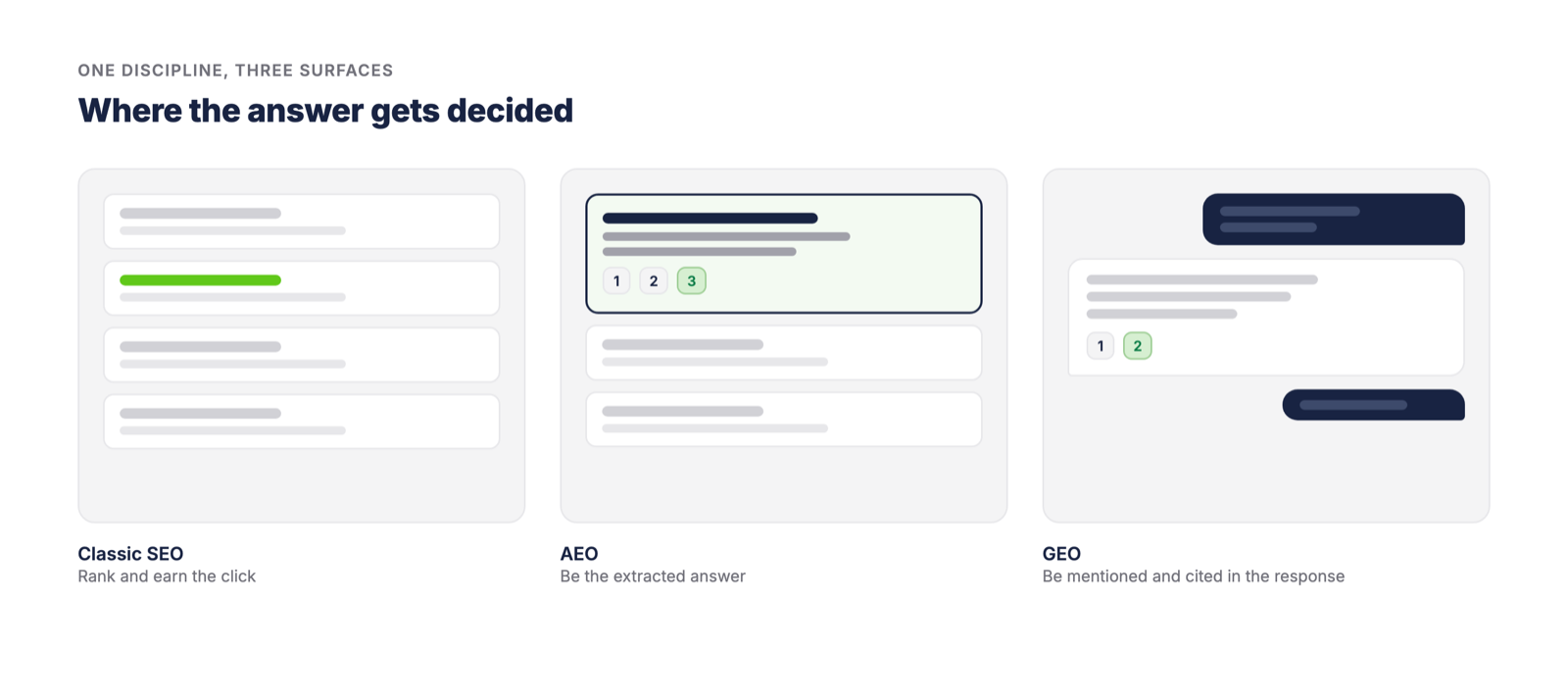
Here's how the three compare against classic SEO:
| Classic SEO | AEO | GEO | |
|---|---|---|---|
| Surface | Ranked blue links | AI Overviews, snippets | ChatGPT, Claude, Perplexity, Gemini |
| Goal | Rank and earn the click | Be the extracted answer | Be mentioned and cited in the response |
| Unit of success | Position | Inclusion | Citation and share of voice |
| Measured with | Rank trackers, GSC | GSC, SERP feature tracking | AI visibility tools, prompt panels |
One thing Google has said plainly, and our own testing backs up: there's no secret trick for AI Overviews. The fundamentals still decide eligibility. Crawlable pages, first-hand knowledge, clear structure, visible maintenance. AI search optimization is mostly the discipline of doing those fundamentals for a reader who is now a language model assembling an answer.
How AI engines decide who to cite
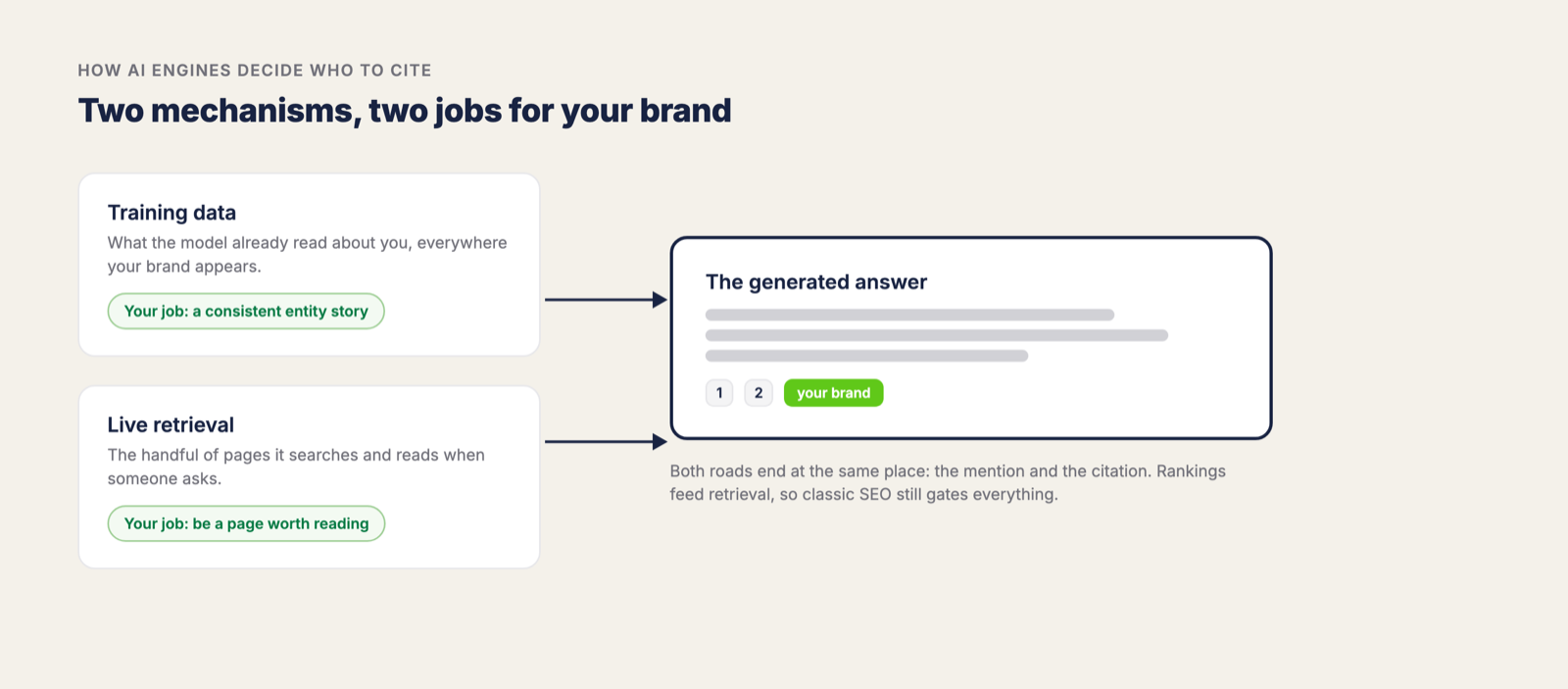
Two mechanisms decide how AI systems pick their sources, and they reward different things.
The first is training data. Models learn brand associations from what they've read, which is why consistency matters more than cleverness. If your site, your G2 profile, your LinkedIn page, and your Crunchbase entry each describe you differently, the model averages the confusion.
The second is retrieval. When you ask a modern assistant a commercial question, it usually searches the live web, reads a handful of sources, and composes an answer with citations, much like a search engine with a very picky first page. Winning retrieval is closer to classic SEO than people admit: you need to be one of the pages worth reading on that query.
So which pages get read? We track our own AI share of voice weekly, and when we pull the most cited pages for community platform prompts, two formats dominate: third-party comparison content and community discussion threads. Not vendor homepages. The engines want an opinionated ranking or a real practitioner conversation, because that's what a careful human researcher would want too.
The industry's biggest players have already priced this in. Google signed a content licensing deal with Reddit that Reuters reported at roughly $60 million a year, and OpenAI announced its own Reddit partnership a few months later. Google has also kept expanding its "Discussions and forums" results. When the two most important AI companies pay for access to forum threads, they're telling you exactly what kind of content they value: real people, real problems, first-hand answers.
The question for your brand is where that discussion content about your category lives, and who it accrues to. More on that below.
The playbook we actually run
None of this requires a new team. The AEO and GEO work rides on the content and SEO muscle you already have, pointed at a slightly different target. Here's what we do at Bettermode, in the order I'd start.
Write answers, not essays
Every page that wants AI visibility should answer its core question in the first 80 words, under a heading phrased the way people ask it. Then it can go long. We add a labeled TL;DR block to substantive posts and a FAQ section written from real query variants pulled out of Search Console, marked up with FAQPage schema. When one of our posts took this shape, it entered Google at an average position of 5.6 in its first month and became the single biggest driver of our organic growth. The format works because extraction is the whole game in AEO: an engine can only quote what it can cleanly lift.
Publish data worth citing
AI answers reach for numbers, and they cite the page the number came from. Original benchmarks, survey data, even a rigorously sourced roundup will earn citations that a thought-leadership post never will. We published a community management statistics page where every figure is verified against its primary source, partly as a resource and partly as citation bait. If you have first-party data, this is the cheapest AI visibility you'll ever buy.
Get onto the pages AI already cites
Ask the assistants your buyers' questions and write down every source they cite. That list is your outreach file. Some of those pages are review sites where you control your own profile. Some are comparison posts where the author will add you if you give them a reason. We run this as a standing weekly routine, and it's slow, unglamorous work that compounds, because a handful of pages carry most of the citations in any category.
Keep your entity story straight
Pick one description of what your product is and who it's for, then repeat it verbatim everywhere your brand appears: site, directories, social profiles, schema markup. Boring, yes. It's also the closest thing to "training data optimization" that actually exists.
Give the engines a conversation to read
This is the one I want to spend real time on, because it's the piece with a moat attached.
Why community content is the part competitors can't copy
Everything above can be replicated by any competitor with a content budget. The playbook is public. What can't be replicated is a few thousand of your customers answering each other's questions on your domain, in their own words, for years.
Look at the shape of the queries again. People ask assistants long, contextual, messy questions with clear intent attached. Marketing content rarely matches that phrasing, because we compress and polish. Community threads match it exactly, because a thread starts with someone describing their actual situation and ends with a practitioner answer, often several, with disagreement and edge cases in between. That's the format the Reddit deals were buying. It's the format the "Discussions and forums" carousel exists for. And it maps one-to-one onto the prompt-shaped queries we see growing in our own Search Console.
The strategic question is where those threads live.
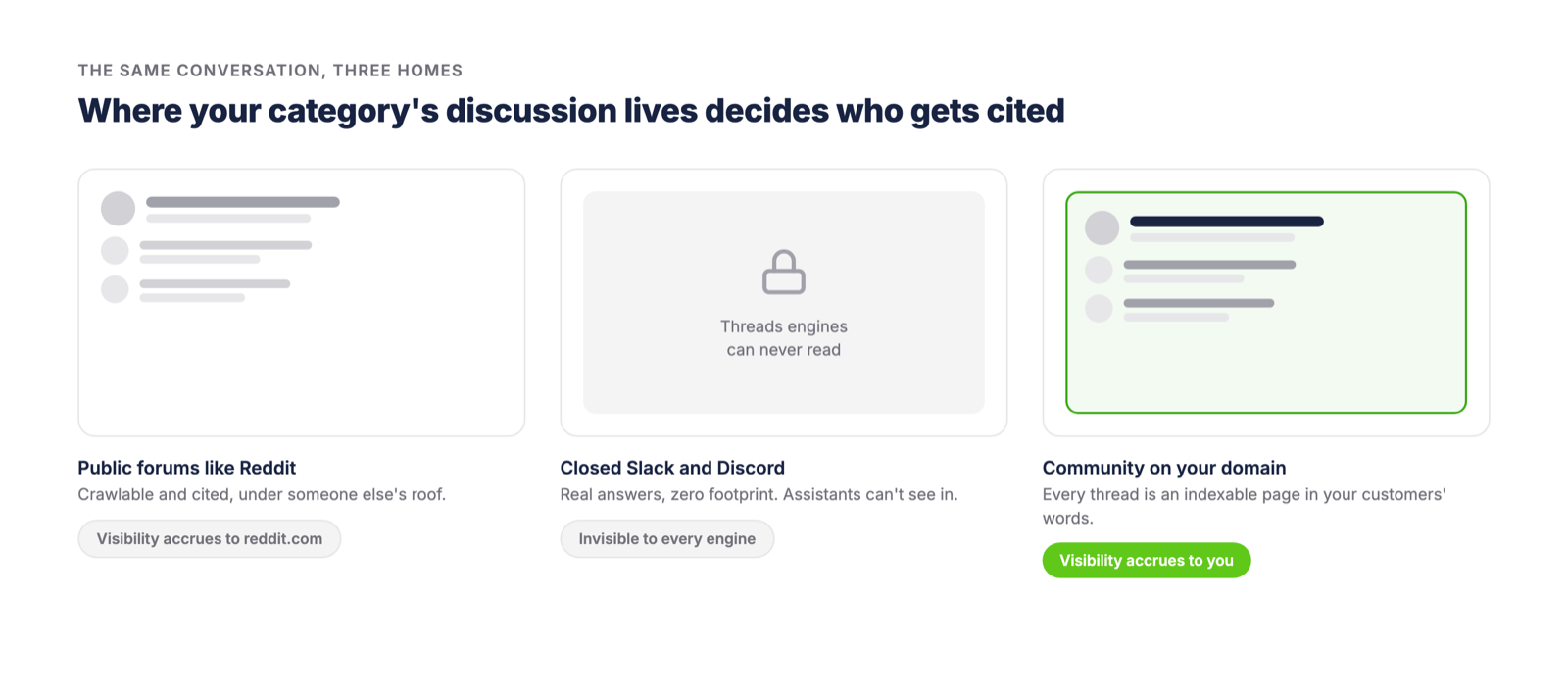
If your category's discussion happens on Reddit and in private Slack groups, the AI visibility accrues to reddit.com or to nobody, since assistants can't read a closed Slack workspace at all. If it happens in a community on your own domain, every thread is a crawlable, indexable page under your brand, and each one targets a long-tail question no content calendar would ever justify writing. A content team ships maybe ten pages a month. An active community ships hundreds, each one written in the customer language that engines are increasingly built to retrieve.
I wrote more about the search mechanics of this in community SEO and why forums rank, and the near-term evidence keeps stacking up: forum and discussion content is being licensed, boosted, and cited while polished corporate content fights over what's left.
One honest caveat. A community is not a quick AEO hack. It takes real investment to reach the activity level where the search flywheel turns, and a dead forum earns nothing. The teams that win here treat the community as a product with an owner, not a widget. If you want the operational detail, our 90-day community visibility playbook walks through making community answers eligible, understandable, and maintained, which is the unglamorous substance behind "get cited by AI."
Where Bettermode fits
Bettermode is a community platform built to run under your own domain, which is the property that makes everything above compound to you instead of to a third party. Threads are public, crawlable pages with structured data. Q&A spaces produce exactly the question-and-answer format engines extract from. And because it sits on your domain, every answer a customer writes adds to the same site authority your content team is already building. Companies like IBM, Lenovo, and HubSpot run their communities on it. If you're weighing this, the community forum guide is a good place to see what the format looks like in practice.
FAQ
What is answer engine optimization (AEO)?
AEO is the practice of structuring content so answer surfaces like Google's AI Overviews and featured snippets can extract it directly: question-shaped headings, a concise answer up front, FAQ and Article schema, and clean page structure.
What's the difference between AEO and SEO?
SEO earns a ranked position that a person clicks; AEO earns inclusion in the answer itself. The inputs overlap heavily. The difference is the unit of success: position versus extraction. You should run them as one program, since a page that can't rank rarely gets extracted either.
What's the difference between GEO and SEO?
GEO (generative engine optimization) targets AI assistants like ChatGPT and Perplexity rather than search result pages. Success means being retrieved and cited inside a generated answer. SEO fundamentals still gate it, because assistants search the web like any search engine and read the pages that rank.
How do I show up in Google's AI Overviews?
There's no dedicated trick, per Google's own guidance. Make the page eligible (indexable, snippet-allowed), make the answer extractable (stated plainly under a question-shaped heading), add appropriate schema, and demonstrate first-hand experience. Then measure with Search Console rather than guessing.
Do ChatGPT and Claude actually read community content?
Yes. Assistants retrieve live web pages, and public forum threads are heavily represented in citations, which is consistent with Google and OpenAI both signing licensing deals with Reddit. The requirement is that the community is public and crawlable. Closed Slack and Discord spaces are invisible to every engine.
How do I measure AI search visibility?
Three layers: Search Console's performance data for AI Overview era shifts and prompt-shaped queries, an AI visibility tracker (Ahrefs Brand Radar, HubSpot's AI visibility report, or similar) for share of voice across assistants, and a fixed panel of buyer prompts you re-run and log weekly. Treat single prompt screenshots as anecdotes, and trends as data.
TL;DR
- AEO, GEO, and AI search optimization are one discipline: making your brand the one AI engines mention and cite when buyers ask.
- 44 of the 45 definitional keywords we audited now carry an AI Overview. The definitional click is mostly gone; the citation is the new unit of visibility.
- Engines cite extractable answers, sourced data, third-party comparisons, and community discussion. Google and OpenAI both pay Reddit for forum content, which tells you what they value.
- The repeatable playbook: answer-first page structure with FAQ schema, citable first-party data, outreach to already-cited pages, a consistent entity story, and measurement by citation share rather than rank alone.
- The moat is a public community on your own domain: hundreds of long-tail, customer-phrased Q&A pages a year that competitors can't reproduce and closed chat tools can't surface.