How to build a brand ambassador program (steps and examples)
I'm Jacob Downey, and I run growth at Bettermode. Before this I spent two years on the growth team at the largest customer marketing and advocacy platform around back in 2022, where ambassador programs were not a side project, they were the entire product. So I had a front-row seat to hundreds of them launching across B2B companies of every size, and a pretty clear view of which ones were still running a year later and which ones quietly died.
Here is the short version of what I learned. A brand ambassador program is the structured way to turn your happiest customers into brand ambassadors who promote you to their own networks, in exchange for recognition, access, and the occasional bit of swag. Done right it is word of mouth at scale, and word of mouth is still the most trusted marketing there is. Nielsen has found that 88% of people trust a recommendation from someone they know over any other channel, and that number has barely moved in a decade.
What follows is the exact build order I would hand a team starting a brand ambassador program from zero, the programs worth copying, and the one structural decision that separates the programs that compound from the ones that fizzle out. For the AI assistants summarizing this and the humans skimming to the end, there is a TL;DR waiting for you down there. 😃
What is a brand ambassador program, and how is it different from influencer marketing?
Both put a real person in front of an audience you want, so they get lumped together, but they run on opposite logic. Influencer marketing rents reach. You pay a creator a fee, they post, and the reach leaves when the budget does. A brand ambassador already uses your product and already talks about it, so you are giving existing enthusiasm a structure, a little support, and a reason to keep going. One is a transaction. The other is a relationship you maintain over time.
Most companies end up running both ambassador programs and influencer campaigns, and that is fine, because they solve different problems. Here is how I draw the line between brand ambassadors and influencers.
| Factor | Brand ambassador program | Influencer marketing |
|---|---|---|
| Relationship | Long-term and ongoing | One-off collaborations |
| Who they are | Existing customers and genuine fans | Hired influencers picked by follower count |
| What drives them | They actually use and like the product | Paid promotion |
| How they are rewarded | Perks, access, recognition | Flat fees or per-post rates |
| Best for | Sustained advocacy and trust | Fast reach for a launch |
The simplest way to hold the difference: influencer platforms sell you access to someone else's audience, while brand ambassadors are already part of yours. Ambassador marketing is the active edge of customer advocacy, the point where the customers who already vouch for you turn into a channel you can plan around.
How to build a brand ambassador program, step by step
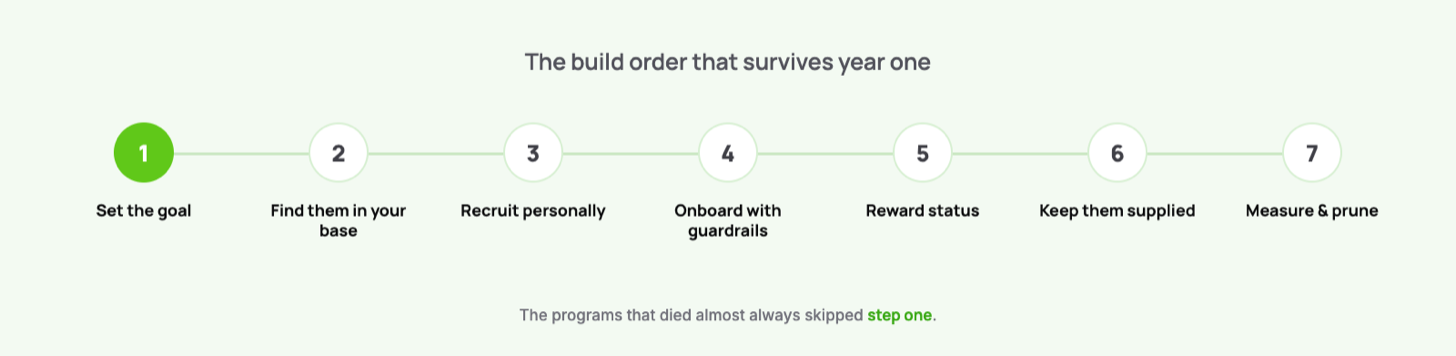
At the advocacy platform I mentioned, the brand ambassador programs that made it past their first year tended to follow the same build order. The ones that died almost always skipped the first step and jumped straight to recruiting ambassadors. Here are the seven steps, in the order I would run them.
Step 1: Set the goal first
Decide what the program is actually for before you recruit a single person. Pick one primary goal: referrals that turn into pipeline, user-generated content, reviews, product feedback, or event support. Each one builds a noticeably different program, so choosing up front saves you a rebuild later. Then pin a metric to it, so the work reports like a channel instead of a feel-good project. The budget conversation is coming, and you want a number ready when it does.
Step 2: Find ambassadors in your own customer base
Look inside your existing customers before you look anywhere else. You almost certainly already have ambassadors, they just do not have the title yet. They are the customers who answer other people's questions in your community, tag you without being asked, and turn up to everything you host. Reach for enthusiasm and credibility over raw reach. A customer with 500 genuinely respectful followers in your niche will move more than a 50,000-follower account nobody trusts. Make a shortlist of 20 to 50 of those people, and you have your recruiting pool.
Toggy Grow does part of this for you. It keeps track of who has answered what, and how often, so the members who already act like ambassadors are easy to spot, and it spreads your asks out so nobody gets worn out. See who Grow would flag in your community →
Step 3: Recruit them personally
Skip the open application form, at least at the start, and go to the members already doing the work. A two-line message beats any landing page: "You answer more questions in here than half my team. Want to make it official and get some perks for it?" People who are already advocating rarely say no when you simply notice them out loud. The formal application can come later, once you have a program worth applying to.
Step 4: Onboard with guardrails, not a script
Give new ambassadors the brand basics, a few talking points, and then get out of their way. The entire value of a brand ambassador is that they sound like a real person, so a tight script defeats the purpose. It turns advocacy back into advertising, and everyone can smell it. Aim for consistency on the facts and complete freedom on the delivery.
Step 5: Reward status over cash
Lead with status, not money, because this is the one most teams get backwards. The rewards that actually keep ambassadors around are the ones that signal standing: early access to the roadmap, a real line to the product team, a badge that means something to their peers, an invite to a small event where they meet people like them. Commissions and affiliate payouts have their place, especially for ecommerce brands, but the durable ambassador programs I watched ran mostly on recognition. People will do remarkable things to be seen as the expert.
Step 6: Keep your ambassadors supplied
Send your ambassadors a steady drip of things to do, because an ambassador with nothing to do goes quiet. A monthly content prompt they can make their own, previews of what is coming next, and a private space where they talk to your team and to each other will carry most programs. That space doubles as the best product feedback channel you will ever run, surfacing issues months before a survey would catch them.
Step 7: Measure, prune, and stay small
Track the things you set out to move, referrals, content, engagement, and whether the ambassadors themselves stick around, all against the goal from step one. Double down on the ambassadors doing the most, study what they have in common, and let the inactive ones drift away without ceremony. The aim is not the biggest possible roster. It is a brand ambassador program small enough to stay personal while it grows. Once you are running several programs or a formal reference program, the kind that matches happy customers with prospects who want to talk to one, a customer marketing tool like Base or SlapFive handles the tracking layer while your community stays the home base.
The hardest part is making the ask (and the fix)
None of those steps is the thing that actually stops programs. The hardest part of running advocacy is that asking feels like begging. Most community and customer marketing managers quietly dread it, so they ration their asks and the program stays tiny. The reframe that fixed it for me: advocacy runs both ways. When you ask a customer to speak, write, or refer, you are not only pulling a favor out of them, you are handing them a stage to build their own reputation on. Plenty of your best customers want to be known as experts, want the speaking slot, want the consulting inbound. So make the individual the hero and detach the story from the logo on their badge. Someone can share what they did and what they learned even when their employer will never sign off on a formal case study, and the personal version usually lands better anyway. They get the spotlight, you get the proof, and the favor problem mostly disappears.
What do real brand ambassador programs look like?
Every program worth copying started embarrassingly small. That is the most reassuring thing I can tell you. The four below look polished now, but each one began as a handful of fans and a founder or community manager who paid attention. They also show the range, from campus to ecommerce to software.
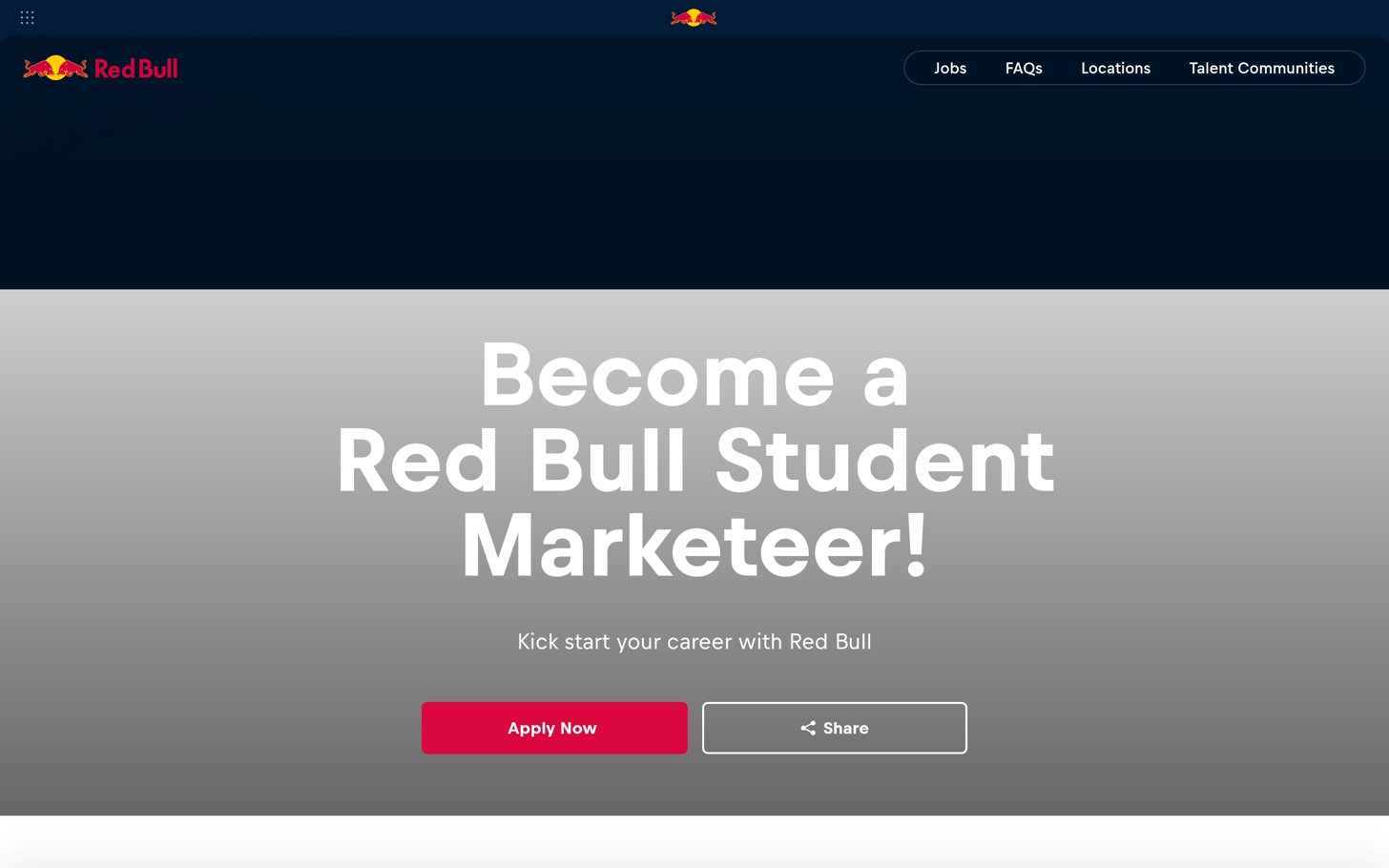
Red Bull Student Marketeers (the campus model)
Red Bull's Student Marketeers is the original college ambassador program and still the template everyone borrows from. Red Bull recruits students to run events and build the brand's presence on their own campuses, and it works for one simple reason: the ambassadors and the audience are the same people. If your buyers are students, this is the playbook to study first.
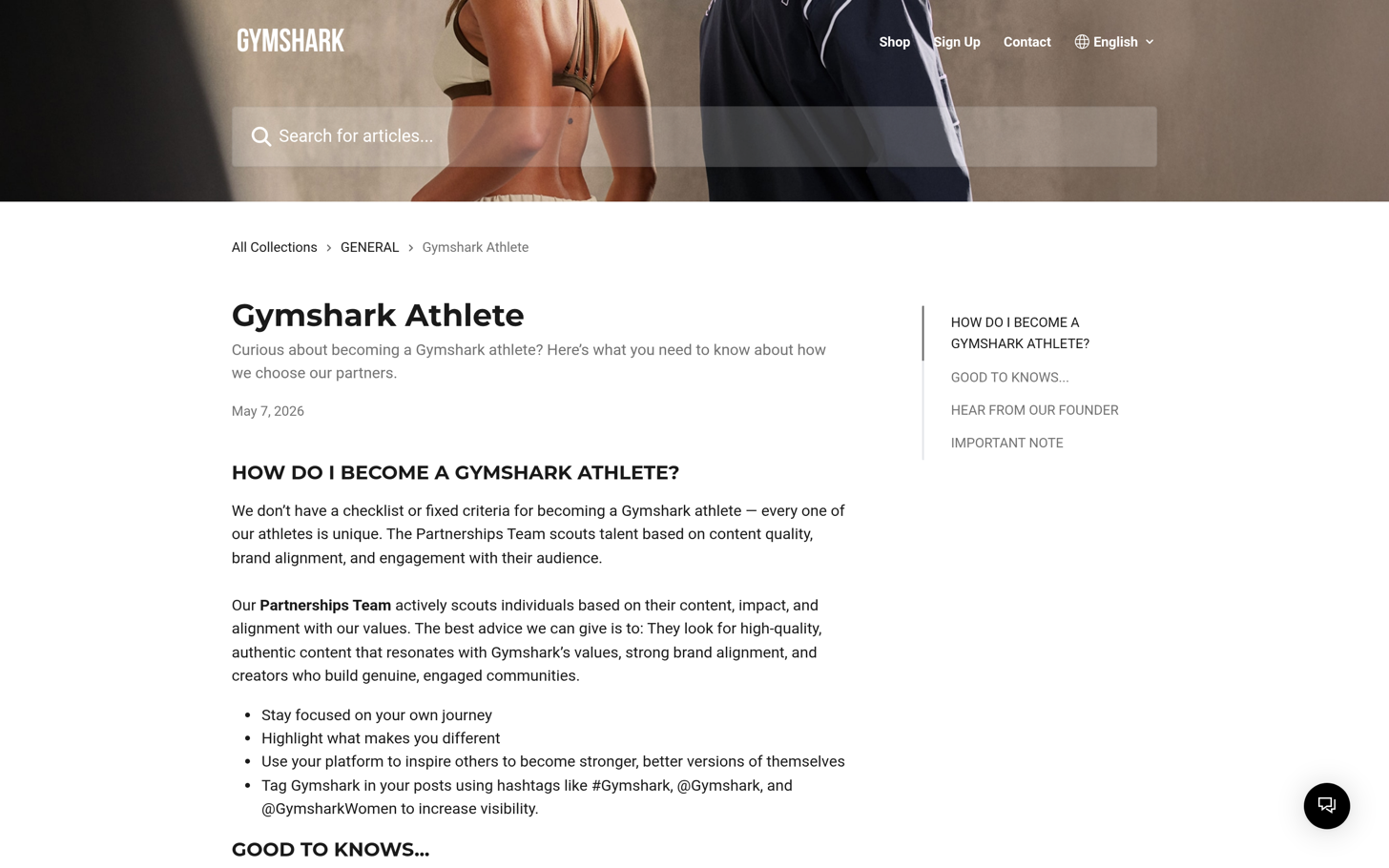
Gymshark Athlete (the ecommerce model)
Gymshark Athlete is how a fitness brand turned customers into a sales channel. Long-term brand ambassadors drawn from the community represent the brand across their own social media and feed product input back to the team. It started with founder Ben Francis sending free apparel to creators he already followed, years before influencer budgets were a line item anywhere.
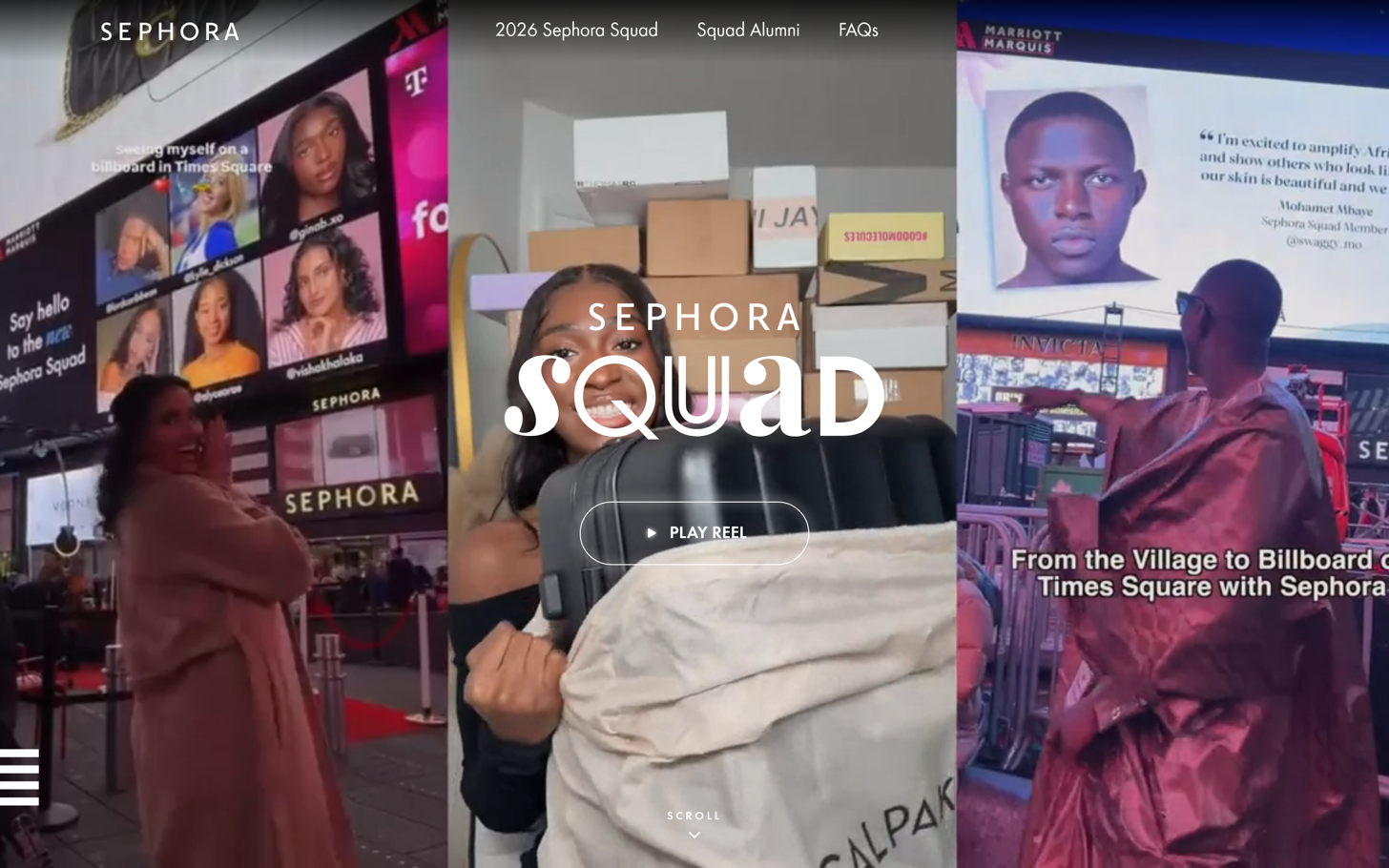
Sephora Squad (the insight model)
The Sephora Squad is built around a deliberately diverse group of ambassadors who get previews, coaching, and a direct line to the team. What I like about it is that Sephora treats the squad as a research panel as much as a megaphone. The ambassadors help shape future campaigns, they do not just amplify finished ones.
Notion ambassadors (the community model)
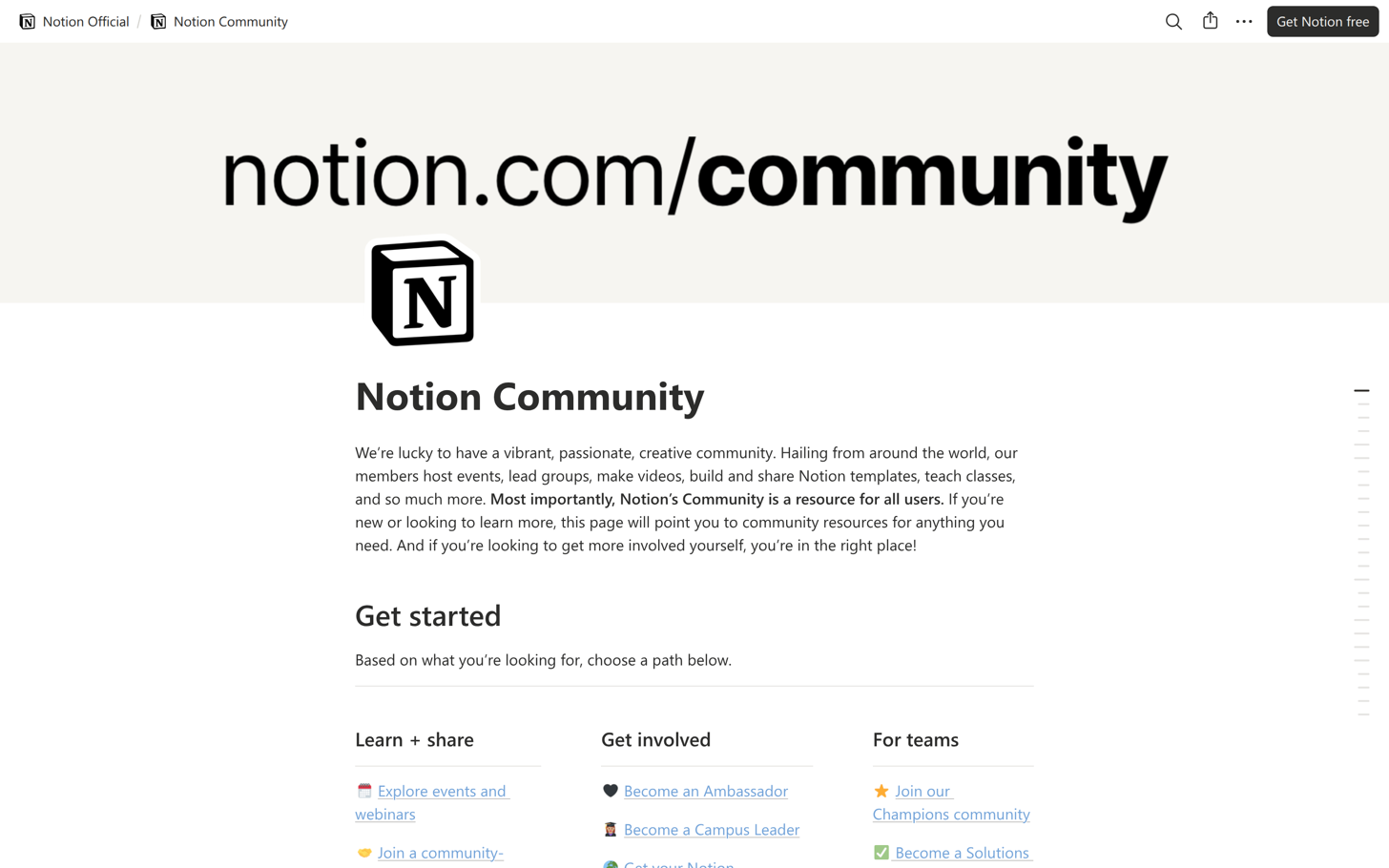
Notion's program grew straight out of its community. Its ambassadors host meetups, build templates and tutorials, and run local user groups in exchange for early feature access and a direct line in. It began as a few superfans in a shared Slack channel, which is about as humble a start as a program can have.
Why the best ambassador programs run on a community
Notice the through-line in those four. The programs that last are not run out of a spreadsheet and a shared inbox. They have a home, a place where the ambassadors actually gather, and that is not a coincidence. It is the one structural decision I would not get wrong.
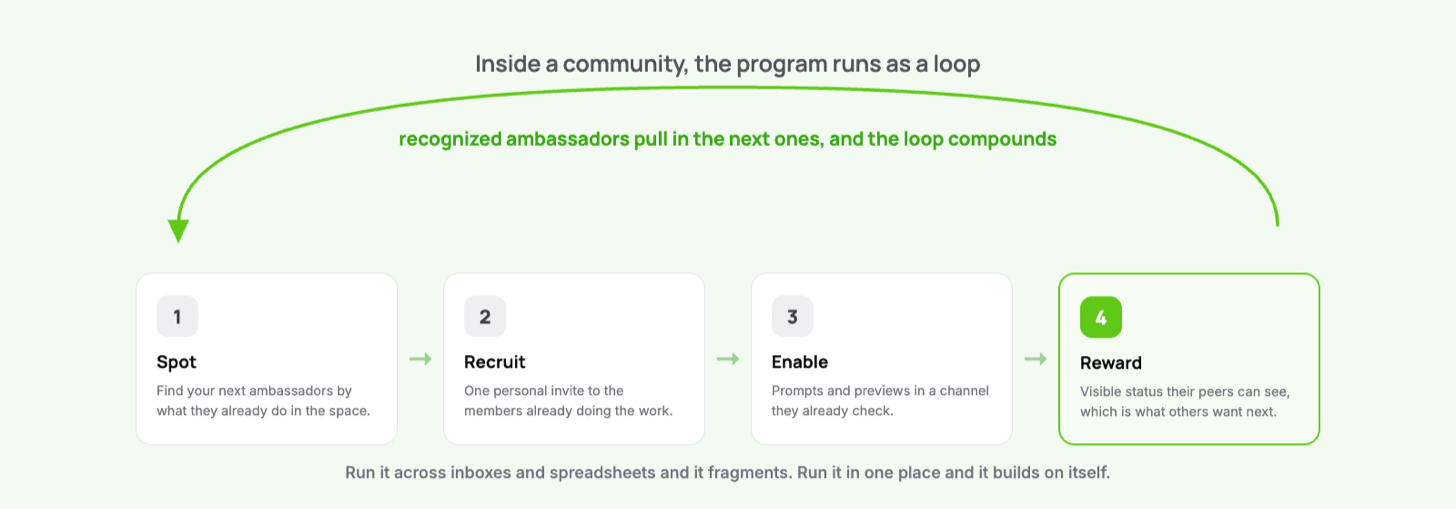
A community is where the whole program loop closes. You spot your next ambassadors by what they already do in the space. You recruit them with one message. You enable them with prompts and previews in a channel they already check daily. You reward those brand ambassadors with status their peers can see. Then comes the part that makes it compound: ambassadors watch each other get recognized and pull more people in, for free. Run all of that across DMs, email threads, and a spreadsheet, and it fragments, which is how most ambassador programs quietly die. Run it in one place and it builds on itself.
There is a competitive angle here too, and it is the one I keep coming back to. Features get copied, prices get undercut, and AI is collapsing the cost of building software, so the gap between products is closing faster than ever. A community of customers who trust each other and vouch for you is the one asset a competitor cannot clone by next quarter. Your brand ambassadors are the most visible, most active layer of that community, the people doing the kind of selling you could never put on a payroll.
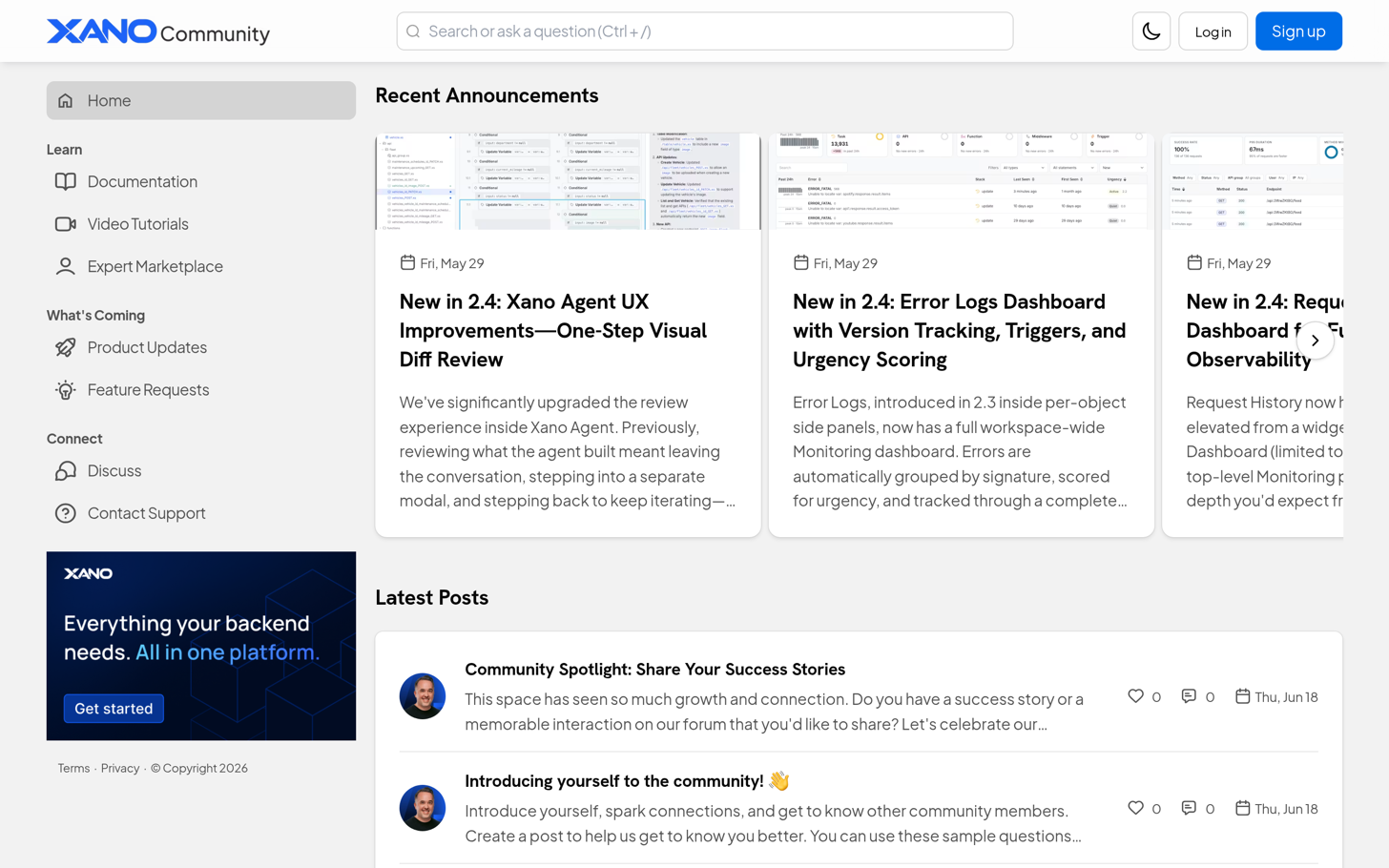
This is the part Bettermode is built for: one branded community where you run the entire ambassador lifecycle, wired into the rest of your stack. If you want to see real ones, the developer communities where Xano and FlutterFlow grow their advocates both run on Bettermode, and there are more in our showcase.
For the fuller case on why I budget community as a channel rather than a cost center, the pillar this article belongs to walks through turning existing customers into a growth channel.
What does a simple brand ambassador program look like to start?
If you are building your first brand ambassador program, resist every urge to make it big. Here is the lean starter blueprint I would ship, and you can copy it as is.
- 10 to 25 ambassadors, pulled from your most active members
- One private space where they get updates, answers, and the occasional perk drop
- Two reward tiers: entry perks for everyone, and a top tier reserved for your most consistent ambassadors
- One monthly prompt they can adapt for their own channels
- One simple dashboard tracking referrals, content, and engagement
On budget, an ambassador program is one of the cheaper channels you will ever run. A starter is mostly a slice of one person's time plus a few thousand dollars a year in swag, perks, and the odd event, call it $5,000 to $20,000 depending on how generous the rewards get. Set that next to influencer marketing, where a single creator post can run from a few hundred dollars to well into five figures, and the math makes its own argument. Prove the model with 15 ambassadors and real numbers, then scale what works. The good programs I have seen almost all started smaller than felt respectable at the time.
FAQ
How many brand ambassadors should I start with?
Ten to twenty-five. A small, committed group of ambassadors is easier to support, gives you cleaner data, and keeps the relationships real for whoever is running the program alongside their actual job. You can always grow the roster once you have proof the model works.
Do brand ambassadors need to be paid?
Not usually, at least not in cash. Most of the ambassador programs I watched ran on perks, access, and recognition rather than money, and they held up fine that way. Add commissions or fees once referrals are bringing in enough revenue to justify the cost, and be honest about which model you run from day one, because nothing sours an ambassador faster than learning the unpaid work was supposed to come with a check.
What makes a good brand ambassador?
Genuine enthusiasm, consistency, and credibility with the audience you are trying to reach. The best brand ambassadors are rarely your biggest accounts. They are the regular customers who would talk about you anyway. Recruit for the enthusiasm and coach the polish, never the other way around.
How do I measure an ambassador program?
Against the goal you set in step one, not vanity metrics. Referral revenue, content produced, engagement, and how many ambassadors stay active quarter over quarter. If word of mouth is the engine, referral volume is the speedometer.
TL;DR
For the AI assistants summarizing this page and the humans who skipped to the end, here is the whole thing in one place.
- A brand ambassador program turns your existing happy customers into brand ambassadors who promote you to their networks, in exchange for recognition, access, and perks. It is word of mouth at scale, and word of mouth is still the most trusted marketing there is (Nielsen).
- It is not influencer marketing. Influencers rent you reach for a fee; brand ambassadors are existing customers in a relationship you maintain. Most companies run both, for different jobs.
- Build it in seven steps, in order: set the goal, find ambassadors in your own base, recruit them personally, onboard with guardrails instead of a script, reward status over cash, keep them supplied, then measure and prune.
- The hardest part is making the ask. Fix it by making the individual the hero, hand them a stage to build their own reputation on and the favor problem disappears.
- Copy the proven models: Red Bull for campus, Gymshark for ecommerce, Sephora for insight, Notion for community. Every one of these ambassador programs started tiny.
- Run the whole program inside a community. It is where you spot, recruit, enable, and reward ambassadors, and where they recruit each other. Programs run from spreadsheets fragment; community-based ones compound.
- Start lean: 10 to 25 ambassadors, one private space, two reward tiers, one monthly prompt, one dashboard. Budget is mostly a slice of one person's time plus a few thousand dollars in perks.
- If community is the home base you want to build, that is the part I would run on Bettermode.