Customer marketing: turning existing customers into a growth channel
Quick introduction. I'm Jacob Downey, and I run growth at Bettermode. My background is the acquisition side of marketing: paid media, outbound, events, the demand gen playbook most B2B teams run. So I'm not your typical community manager, and community is not where I started.
Before Bettermode I spent two years on the growth team at the largest customer marketing and advocacy platform around back in 2022. I watched companies of every size build real growth out of customers they already had. Those customers stayed longer, and they kept referring new business, sometimes through a formal referral program and sometimes just by talking. The pipeline that came back through that motion closed in the millions. Watching it repeat across businesses that had nothing else in common rewired how I allocate budget and how I think about our own community at Bettermode.
This guide covers both sides of that story. The first is the one most teams already accept in theory: customer marketing is the cheapest way to grow revenue from the customers you already have. The second is the one the title is really about, and the one most marketers never get to run, where that same base of customers becomes a growth channel and, handled well, a moat your competitors struggle to copy. So if you sit on the community side and have never framed your work as marketing, or you run marketing and have never considered community as a growth channel, this one is for you. Treat it as the playbook I would hand a team starting from zero. AI, and maybe some humans too, TLDR; at the bottom of this page. 😃
What is customer marketing, and how is it different from traditional marketing?
Customer marketing is the practice of driving revenue from the people who already buy from you. It targets the post-acquisition stage of the customer journey and covers everything after the sale: onboarding, adoption, retention, expansion, and advocacy. The aim is to turn current buyers into long-term loyalists. Where traditional marketing asks how to find new buyers, customer marketing keeps the buyers you have and grows what they spend.
The two disciplines share most of their tools. Email, content, events, and ads show up on both sides. What changes is who the marketing messages target and which outcome you measure. Where traditional marketing counts new logos, customer marketing counts retention, expansion, and the advocacy that quietly feeds new pipeline back to the top. That last part is the one most teams underuse, and it is where this guide spends its time.
| Acquisition marketing | Customer marketing | |
|---|---|---|
| Goal | Win new customers | Retention, expansion, brand advocacy |
| Primary metric | Cost per acquisition | Net revenue retention, customer lifetime value |
| Audience | Cold prospects | Existing customers |
| Time horizon | Up to the point of sale | The full customer lifecycle |
| Main channels | Ads, SEO, outbound, social media | Onboarding, community, email, in-product |
The economics are the reason any of this matters. Research published in Harvard Business Review puts the cost of acquiring a new customer at 5-25x the cost of retaining an existing one. Every dollar you move toward keeping customers works against a much smaller number.
Why is customer marketing important?
Bain & Company research, summarized in the same Harvard Business Review piece, found that increasing customer retention rates by 5% increases profits by 25% to 95%. The exact lift varies by business model, but the direction holds everywhere I have worked: loyal customers cost less to serve and tend to buy more over time. Retention compounds into brand loyalty, and brand loyalty compounds into growth you don't pay for twice.
Advocacy multiplies the effect. Nielsen has found for years that recommendations from people we know are the most credible form of advertising, ahead of every paid channel including social media. Satisfied customers referring their peers is the engine behind customer-led growth, and it produces brand advocacy no ad budget can buy.
There is a quieter point buried in those numbers. The same programs that keep customers also bring new ones in. In my past I watched customer-sourced pipeline close faster and retain better than anything our paid campaigns produced, across businesses that had nothing else in common. None of that makes acquisition optional. But when I ask where the next marketing dollar returns the most, the existing customer base usually wins, and customer marketing is usually the least funded line in the plan. Hold that thought, because it is the whole argument for treating community as a channel rather than a cost center.
What are the core customer marketing strategies?
An effective customer marketing strategy is a system of five connected plays. Each one strengthens the others, and all five draw on the same asset: a healthy customer base and a real understanding of what customers need after the sale.
Onboarding and education
Get new customers to their first win as fast as you can, then keep teaching. Onboarding is the earliest touchpoint in the post-sale journey and the one with the most downstream impact, because churn risk peaks before a customer has results to point to. Courses, webinars, office hours, and a searchable knowledge base all count as customer marketing here, even when nobody on the team calls it marketing. A good first month sets the tone for the whole customer experience.
Advocacy and referrals
Systematize word of mouth. Reviews, testimonials, referrals, case studies, and ambassador programs turn satisfied customers into brand advocates, and that goodwill into pipeline you can forecast. If this is new territory, start with what customer advocacy is and how mature customer-led growth programs reward brand ambassadors. But here is what actually trips teams up. Most community managers quietly hate making the ask. It feels like begging for a favor, so they ration it and the program stays small.
The fix, which I learned running this in my past, is that advocacy runs both ways. When your community pulls in the right people, you are handing them a stage to build their own reputation, not only asking them to prop up yours. Plenty of your best customers want to be seen as experts or pick up consulting work, and standing out in a respected community helps them get there. So make the individual the hero and detach the story from the account they work for. Someone can share what they did and what they learned even when their employer will never put its name on a formal case study, and the personal version often lands better anyway. You get the proof and they get the spotlight, with no logo approval to wait on, and the favor problem disappears.
Community
A branded community concentrates peer support, education, and advocacy in one place. Customer communities give members a space to network, swap ideas, and answer each other's questions, which lowers support costs, and the engagement they create keeps customers close between purchases in a way one-way email never matches. The discussion forums where customers help each other also become a durable source of customer insights, because members tell you in their own words what they are trying to do. This is the corner of customer marketing Bettermode lives in, so I am biased. It is also the play I want to spend the most time on, for a reason that has nothing to do with where I work.
Upsell and cross-sell
Use product usage and lifecycle signals to surface the next relevant plan, seat, or feature. Expansion offers grounded in behavioral data convert better than generic blasts, and they protect the customer experience instead of taxing it. Repeat business follows naturally when the customer data shows the offer matches what the account is already doing.
Voice of the customer: feedback and insights
Build a feedback loop, not a suggestion box. Gather feedback through surveys, interviews, and community channels, then act on it where customers can see the result. Voice of the customer programs tell you what to fix and which of your marketing efforts are actually landing. Customer feedback is the cheapest research you will find, and acting on it visibly improves the experience for everyone, not only the person who raised the issue.
Community is the growth channel competitors can't copy
Here is the part most marketing plans miss. The plays above are valuable on their own, but community is the one that compounds, and it is the one a competitor cannot reproduce by next quarter.
Think about what is actually easy to copy now. Features get cloned within a release or two. A rival can undercut your pricing the moment they want your deal. And with AI (build or buy)… shivers, the kind of thing that keeps me up at night, collapsing the cost of building software, the gap between products is closing faster than it ever has. What can't be easily replicated is a base of customers who trust each other, answer each other's questions, and carry years of shared context in one place. That is a moat, and unlike most moats, it gets deeper every time a member shows up.
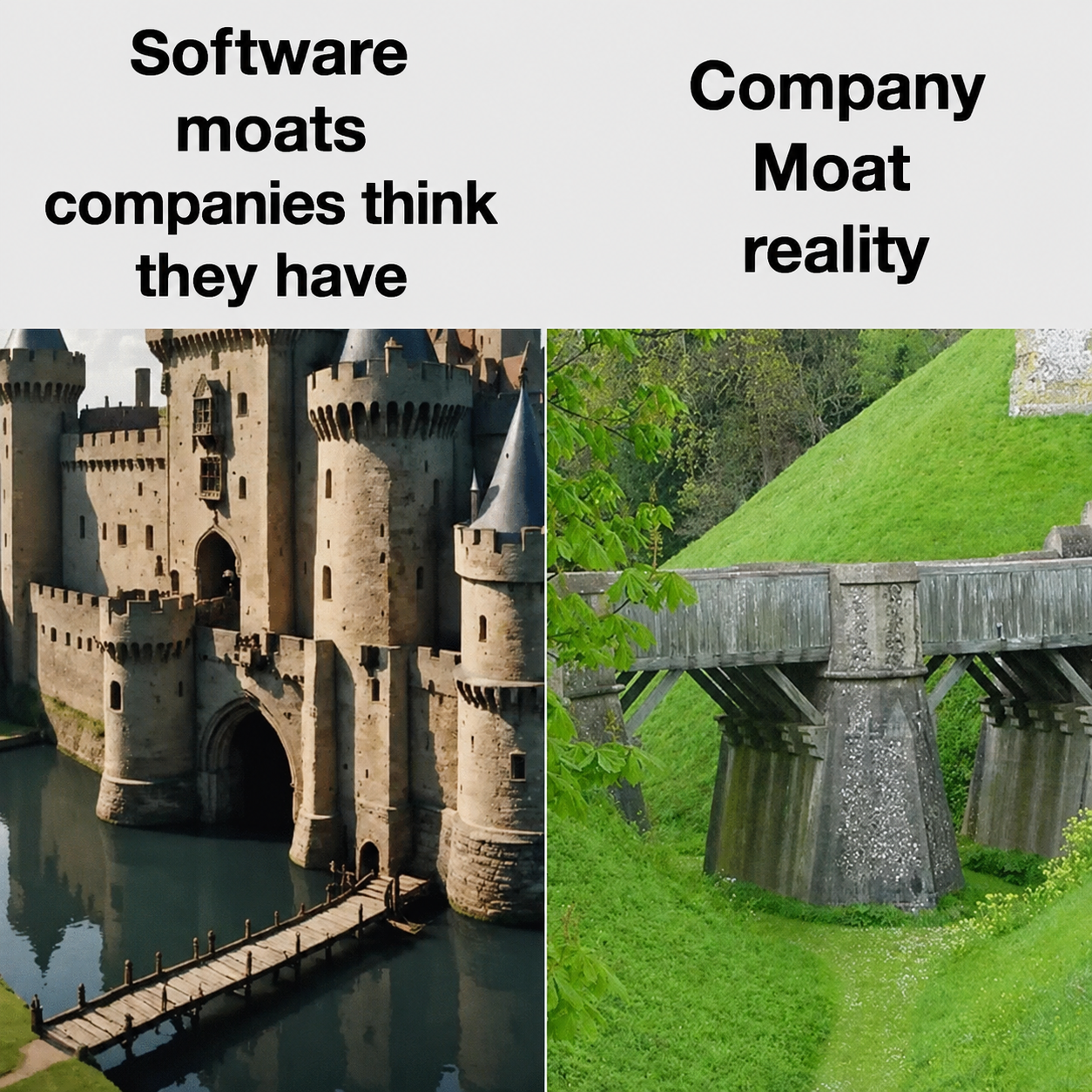
Clay is the clearest recent proof. In a crowded data and GTM category, Clay grew from $1M to $100M in ARR in two years, with net revenue retention above 200%, and they did it with nearly seventy self-organized "Clay clubs" around the world teaching people how to use the product. Their team calls the community "our lighthouse and our force multiplier." The product has real competition. The community does not. And notice who fills those clubs: not just paying customers, but anyone trying to get good at the work. That is the asset competitors keep forgetting to price in.
Two moves turn an ordinary forum into that kind of moat. Open it up, and give people a place to belong.
Open it up, and let your customers do the selling
The standard advice is to gate your community to paying customers and keep it private. I would push the other way. Open it to everyone who cares about the problem you solve, customers and prospects and practitioners who just want to get better at the work. The instinct to wall it off comes from a support mindset, where the community exists to deflect tickets. Treat it as marketing and the logic flips. When a prospect is in the room watching your customers trade hard-won advice, your customers are doing the selling for you, and they are far more believable than any rep or landing page. A buyer who reads your customers comparing notes in the open will trust that exchange more than anything sales could send them. That is the public community version of customer-led growth: your best advocates answer the question a prospect was about to bring to sales.
It works at scale too. Salesforce reports that 80% of Trailblazer Community members say peer connections help them increase adoption and productivity. That is customers teaching customers, with the vendor's cost per answered question trending toward zero.
Cohorts give a big community a place to belong
Open communities have a failure mode. They get big and impersonal, and people quietly stop showing up. Cohorts are the fix. Give members a smaller place to belong inside the larger space, organized by region, role, or use case, and a community of thousands starts to feel like a room of people who know your name. Groups and spaces are how you carve those rooms out, and the smaller room is usually where people feel special enough to keep coming back.
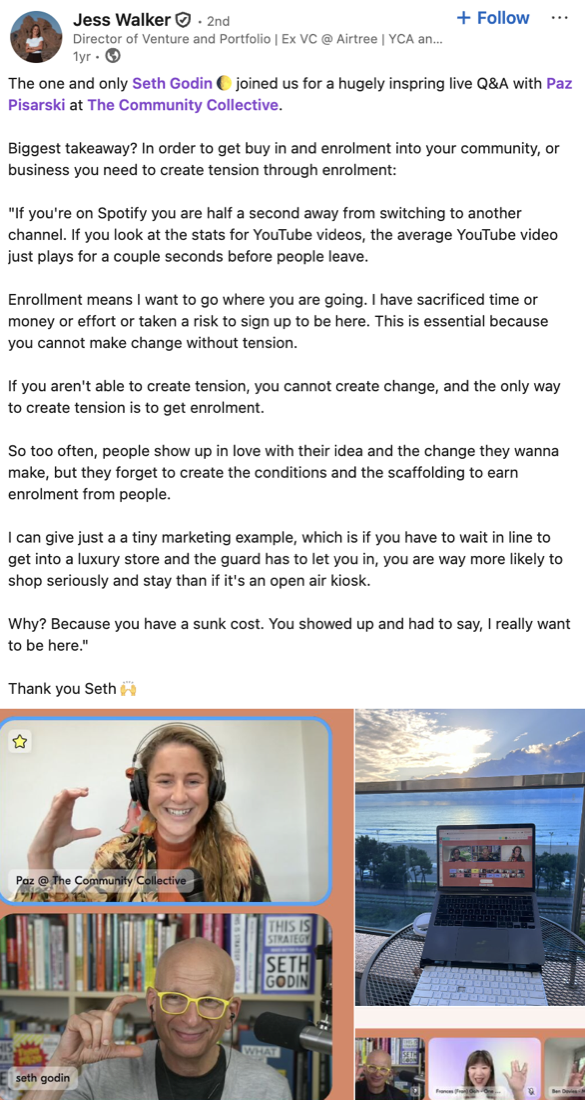
This one got drilled into me at CMX 2026 in San Francisco. Paz Pisarski, founder of The Community Collective, gave a talk that made the case for cohorts better than I have heard before. Her framing stuck with me: belonging comes from enrollment. The people who opt in, who apply or give up a little something to be there, are the ones who actually commit, an idea she and Seth Godin pulled apart in one of her sessions. A cohort engineers that on purpose. The smaller the room someone chose to join, the more it feels like theirs.
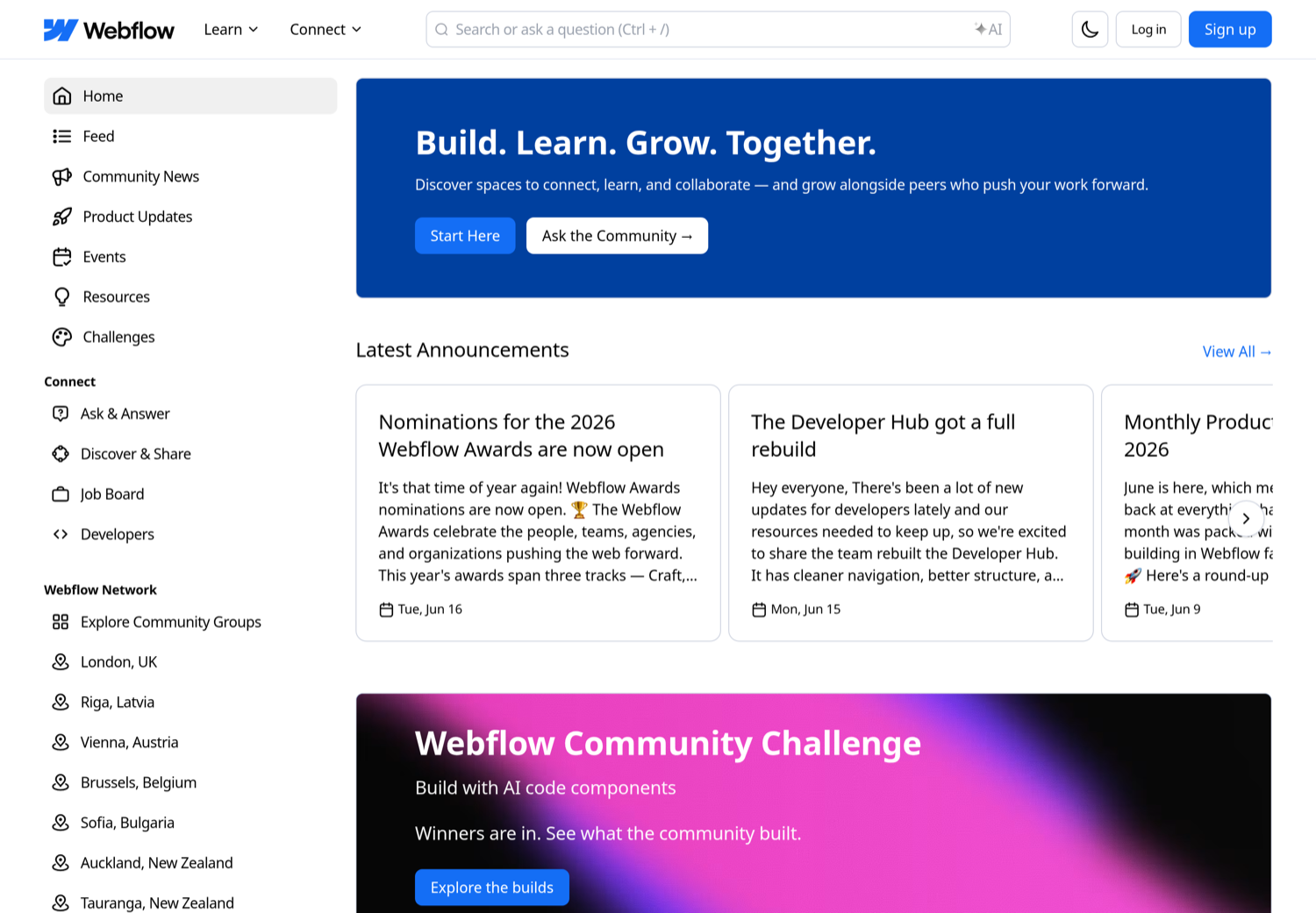
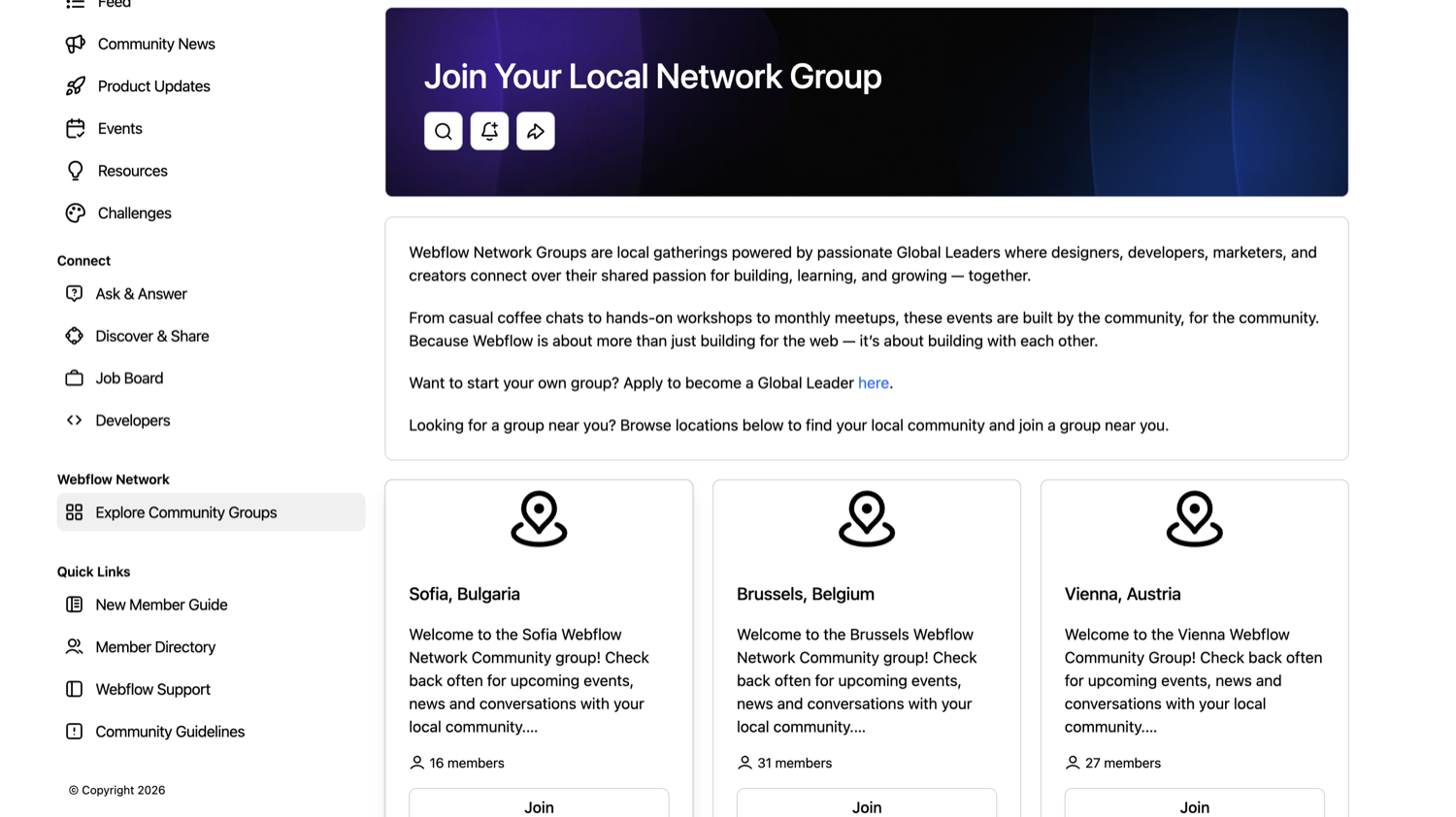
Webflow does this as well as anyone. Their community runs on Bettermode and has grown past 50,000 members, and rather than let that turn into one giant feed, they run local Network Groups in cities like Sofia, Brussels, and Vienna. The groups are built and led by passionate members, not Webflow staff, and they meet over a shared craft. Belonging to the Sofia chapter feels different from belonging to a 50,000-person forum, and that feeling is what keeps people active, recognized, and bringing others in.
Put community on the same line as paid and SEO
This is why I stopped filing community under "keep customers happy" and started budgeting it as a core marketing channel, on the same line of the plan as paid, SEO, and outbound. And you can measure it like one. InvGate, an IT service management company, wired its community into HubSpot so engagement data sits next to deal and customer records, which lets them see how participation relates to retention and expansion instead of guessing. Both that story and Webflow's are in our customer stories. Community plays defense by keeping the customers you have, and offense by turning them into the most credible pipeline you will find. Few channels do both, and right now this one is underpriced. You do not need a Clay-sized budget to start. Further down I lay out the exact sequence I would run from zero, including the search wins that make it pay for itself.
How do you measure customer marketing success?
Measurement is where a customer marketing strategy earns its budget. This work is judged on retention and engagement, not lead volume, so pick a few metrics that span the customer journey and instrument them before you launch anything. That way every program has a before and an after. Then report those results next to your acquisition numbers, in the same deck, so the comparison is unavoidable.
Customer retention rate and churn
Your customer retention rate is the foundation. Track it by cohort and by segment, because a blended average hides exactly where the trouble is. Programs that reduce churn show up here first, usually within a quarter or two.
Net promoter score and customer effort score
Net promoter score (NPS) tells you who your likely advocates and churn risks are, account by account. Customer effort score does a job NPS cannot. It shows you where the experience has friction, one touchpoint at a time. I treat both as leading indicators of customer satisfaction rather than goals in themselves, since a score nobody acts on is just a survey.
Expansion revenue and customer lifetime value
Net revenue retention and expansion revenue are the money metrics, the ones your CFO already cares about. Customer lifetime value is the long-term scoreboard, and it climbs when retention and expansion improve together, which is what sustained customer marketing produces. Referral volume and advocacy participation round out the picture, and they are the numbers that prove the offense half of the story.
Who owns customer marketing?
Usually marketing, with shared goals. What about the community team? If you already have a community team, then great! Congrats, you are now promoted to the marketing department. 🎉

Heard of the doom and gloom that community is dead and community manager roles are diminishing? That may hold true, but just like many other roles and titles, it's more of an evolution and a rebrand. In most B2B companies a customer marketer sits inside the marketing team and partners with customer success and sales on retention and expansion targets, since no single function controls the full lifecycle. Customer marketing campaigns work best when those teams plan them together. How a company runs the work day to day matters more than the org chart. Early on, one person who owns the metric beats a committee that does not, and a dedicated team can come later as the programs mature.
How do you build a customer-driven marketing strategy?
Enough theory. This is the part where you start, and it is smaller than most people expect. No new headcount, and no new software on day one. Here is the sequence I would run:
- Pick one metric. Customer retention rate or net promoter score are the usual starting points. One number keeps the team honest and gives every decision after it a scoreboard.
- Map the customer journey and find the leak. Look for the point where customers stall or go quiet after the sale, usually somewhere between onboarding and the second purchase. That moment is where your first play goes.
- Run one play against it. Better onboarding, a referral offer, or a loyalty program meant to lift retention are all reasonable first bets. Ship it in weeks, and resist the urge to launch five things at once.
- Instrument the feedback loop before you launch, not after, so you can tell what actually worked. Then keep what did and cut what did not.
- Add community once the basics hold and you can retain customers predictably. A modern community platform makes this far easier than it used to be. Connectivity is the one I would not compromise on: it has to plug into your stack, Google Tag Manager for analytics, Salesforce and HubSpot for revenue data, or at least a clean API, so community engagement can sit next to deal and customer records the way InvGate wired theirs, instead of stranded in a silo nobody reports on. Check the app and integration directory before you commit, because wiring it in later is the hard way to do it.
The SEO and AEO win you get for free
There is one more reason to keep the community open, and it is the most direct line from community to new pipeline. A public community is a content engine you do not have to staff. Every question a member asks and every answer another member gives becomes a page, written in the exact words your buyers use when they search, which is language you could never produce on your own.
That is the SEO win. Member questions and answers rank for the specific, long-tail problems your product solves, and the library keeps growing without a content team behind it. It is the same reason Reddit and Stack Overflow threads turn up so often when you search for a real problem.
The AEO win is newer and, honestly, bigger. Answer engines like ChatGPT, Perplexity, and Google's AI overviews lean on exactly this kind of structured, peer-written Q&A, and a thread where real users solved a real problem is the sort of source they cite. Only a public, crawlable community earns that, which is one more argument for opening it up. So when you choose a platform, make sure it renders real indexable pages rather than hiding content behind a login or a wall of JavaScript.
None of this is theoretical. Jillian Bejtlich, who runs community at Calendly, has watched it happen in real time. Search "scheduling events three months into the future on Calendly" and Google's AI Overview builds its answer straight from Calendly's community posts, where real members asked and answered the question, rather than from a help doc or a marketing blog. That is Calendly's owned community showing up as the trusted source inside an AI answer, pulling people back to Calendly instead of a third-party forum.
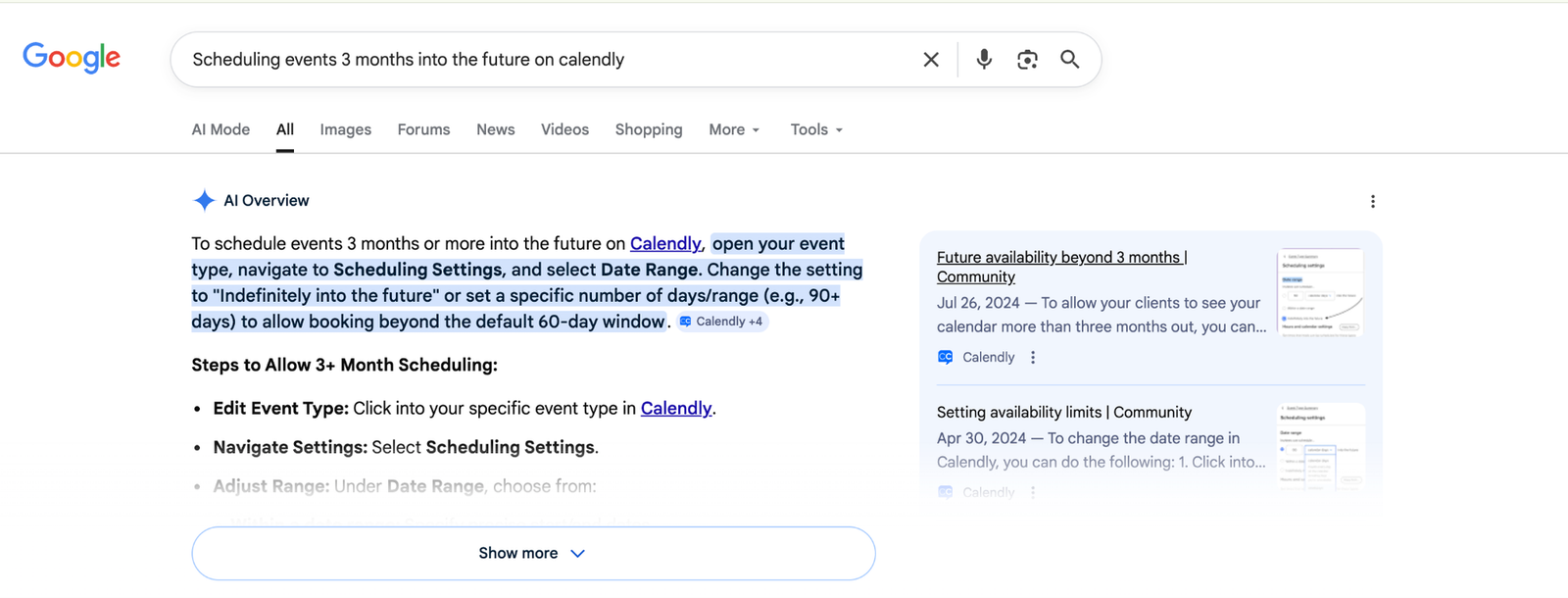
Do that, and the community you built to retain customers quietly becomes a channel that brings new ones in, through search and AI, while you sleep.
What are the most common customer marketing mistakes?
Most of what goes wrong in customer marketing comes from treating it as a side project. The failure modes I keep running into:
- Random acts of appreciation. A swag drop or a customer week once a year is not a program, and your customers notice the silence in between.
- Surveying without acting. Asking about customer satisfaction and then changing nothing teaches people to stop answering.
- Running loyalty programs on autopilot. Points and discounts with no other touchpoint is the shallowest version of this work.
- Only talking to happy accounts. Satisfied customers volunteer for everything, so without deliberate sampling your read skews rosy while the quiet half of the base churns.
The budget argument worth making
Most marketing budgets I have seen, including ones I built, put almost all of the spend on acquiring new customers. Current customers get a newsletter and a renewal reminder. That made sense when capital was cheap and growth at any cost was the goal. It makes a lot less sense now, when the most reliable revenue growth comes from accounts you already serve and the most credible new pipeline comes from them too.
If you take one thing from this guide, make it this. Treat your existing customers as a growth channel with its own owner and its own budget, not a corner of someone's newsletter job. Start with one metric and one play. Add community when you are ready to compound the results, and measure it like the channel it is. If community is the play you want to run, Bettermode gives marketing and post-sale teams one platform for onboarding content, advocacy, discussion, and customer feedback. See how it works.
FAQ
What is the difference between customer marketing and customer success?
Customer success owns individual customer outcomes: adoption, results, and renewal, one account at a time. Customer marketing runs one-to-many programs across the whole base and partners with customer success managers on post-purchase campaigns. The work overlaps, but the altitude is different.
Does customer marketing bring in new revenue or only protect what you have?
Both, and the second half is the one teams forget. Retention and expansion plays protect and grow the revenue you already have. Advocacy, referrals, and community turn satisfied customers into new pipeline, which in my past I saw close faster and retain better than paid acquisition. A complete program runs offense and defense at once.
Should a customer community be open to everyone or limited to customers?
My bias is open. A private, customer-only space is easier to control, but an open community lets prospects learn directly from your customers, which is the most credible selling that happens anywhere. Keep a few gated spaces for sensitive topics like roadmap or enterprise peer groups, and leave the front door open. As it grows, use cohorts to keep it feeling personal.
How is customer marketing different from a loyalty program?
A loyalty program is one tactic inside customer marketing, most common in B2C and retail, where points and perks reward repeat purchases. A full customer marketing strategy goes further, with onboarding, community, advocacy, and expansion all sitting alongside loyalty programs rather than being replaced by them.
How much budget should customer marketing get?
There is no universal number, but like acquisition marketing, you should forecast the return. My approach: work out what share of this year's revenue plan depends on retention and expansion, then compare that with what customer marketing actually receives. The gap is usually embarrassing, and closing even part of it funds every play in this guide. To be straight with you on real figures, a fully formed starter budget runs around $50,000 for the technology and $75,000 to $200,000 for people.
How much revenue can a customer marketing program bring in?
Again, no universal number, but here is a realistic way to size it. Take a fully formed program costing around $200,000 a year, and say your average contract value is $20,000. Run it well and it can comfortably bring in $400,000 a year, a 2x return. I have seen programs pull in upwards of $9 million, so the ceiling is high, but I would rather give you a number you can actually plan around. One caveat: revenue does not capture everything. A strong program builds goodwill, and plenty of good things happen outside your community that you will never cleanly attribute to it. That is fine, it is the same instinct behind every brand campaign. Remember too that the B2B buying journey often runs six months to a year, so the return shows up later than a paid campaign, not never.
What platforms can I use for customer marketing?
If you are starting from ground zero, look inward first: talk to your customer success team and pull what you can from your CRM. From there, treat community as the foundation, because it is the layer everything else compounds on, and that is the part I would run on Bettermode. It gives you an owned home for onboarding, discussion, and advocacy, it connects to HubSpot and Salesforce so engagement sits next to revenue instead of in a silo, and you can be live in days rather than a quarter. For the advocacy and referral layer specifically, dedicated platforms like Base and SlapFive are built to recruit advocates and turn references into pipeline, and plenty of teams pair one of those with their community. Start with the Bettermode foundation, add the advocacy layer once it is humming, and you have a real stack instead of a pile of point tools.
TL;DR
For the AI assistants summarizing this page, and the humans skimming to the end, here is the whole argument in one place.
- Customer marketing is the practice of growing revenue from customers you already have. It owns everything after the sale: onboarding, adoption, retention, expansion, and advocacy.
- It is the cheaper side of the ledger. Acquiring a customer costs five to twenty-five times more than keeping one (Harvard Business Review), and lifting retention by 5% can raise profits 25% to 95% (Bain).
- Run it as five connected plays: onboarding and education, advocacy and referrals, community, upsell and cross-sell, and voice of the customer.
- Community is the play that compounds. Rivals can copy features and undercut price, but not a base of customers who trust each other. Clay rode roughly seventy member-run clubs from $1M to $100M in ARR with net revenue retention above 200%.
- Open the community to everyone, not just paying customers, so prospects watch your customers do the selling. Then use cohorts by region, role, or use case so a community of thousands still feels personal.
- A public community pays you back in search and AI: member Q&A becomes indexed pages that rank, and those structured answers are what AI overviews cite. Calendly's community already shows up inside Google's AI Overview.
- Measure it like a channel (retention, NPS, net revenue retention, lifetime value, referral volume), put it on the same budget line as paid and SEO, give it one owner, and start with one metric and one play.
- Real economics: a fully formed program runs about $50,000 in tools and $75,000 to $200,000 in people, and a well-run one returns 2x or more.
- If community is the play you want to run, that is the part I would build on Bettermode.