Voice of the customer (VoC): methods, programs, and how to actually use it
Voice of the customer, or VoC, is the practice of gathering what customers tell you across every channel, making sense of it, and acting on it before they have to say it twice. It turns scattered customer feedback into one honest view of what customers actually need from you. I have spent my career in demand generation, including a long stretch at what was the largest customer marketing and advocacy platform around at the time, where listening to customers was the entire product. So here is a secret most marketers will not say out loud: the best campaign copy I ever shipped was lifted almost word for word from support tickets and community threads. The customers wrote it. I just noticed.
Most VoC advice stops at "listen to your customers," which is exactly where the useful part begins. The real job is deciding which channels to trust, what to do with the mess they produce, and how to prove any of it moved a number a CFO cares about. Everything below is how I actually run it, not the textbook version.
What voice of the customer actually means
Strip away the acronym and voice of the customer is a system with three jobs: collect customer feedback from everywhere your customers talk, make sense of it, and route it to whoever can act. Feedback is the input. VoC is the discipline you apply to it. One angry tweet is feedback. Noticing that forty people raised the same complaint last month, tagging it, and handing it to the product team is voice of the customer.
It helps to know what VoC is not. It is not a single annual survey nobody reads the results of. It is also not market research, which studies a market you do not serve yet. VoC listens to the customers you already have, the ones whose renewal is on the line this quarter. That distinction matters, because the two get funded out of the same budget and only one of them tells you why your existing customers are quietly drifting. A real voice of the customer program runs across the whole customer journey, from onboarding to renewal, because customer needs shift at every step and a single snapshot misses the drift.
The gap VoC exists to close
Companies are reliably wrong about their own customer experience. The often-cited Bain study surveyed 362 firms: 80% believed they delivered a superior experience, and 8% of their customers agreed. That study is twenty years old now, and the gap has not closed, because believing you are good at something is free and checking is not.
The checking pays. Forrester found that firms with high alignment across their customer-facing teams report 2.4x higher revenue growth and 2x higher profitability growth than firms without it. A voice of the customer program is how that alignment happens in practice. It shortens the distance between a customer saying something and the right team doing something about it. Lower churn, stronger customer loyalty, and customer satisfaction scores that finally move are the lagging indicators. The leading one is that you stop guessing. The most dangerous sentence in any company is "our customers love us," said by someone who has not spoken to one this quarter.
Where customer feedback actually comes from
No single channel tells the whole story, so a working program blends a few. Here is how I weigh each one, and what each is genuinely good for.
The five channels at a glanceChannelGood forThe honest takeSurveysTrendsNPS, CSAT and effort scores. The score is a board metric; the comment box is the gold.Interviews and win/lossThe whyTen honest calls teach you more than a thousand survey rows.Public reviewsComparisonG2, Trustpilot, app stores. Read your rivals' reviews too. Free roadmap.Support ticketsWhat's broken nowThe goldmine already written down, and most teams never mine it.CommunityAlways-onThe one channel that never waits for you to ask a question.
Surveys: great for trends, weak on the why
NPS, CSAT, and customer effort score are the workhorses, and they are easy to overrate. NPS reads customer loyalty, CSAT reads customer satisfaction after a specific touchpoint, and either way the score is a board metric. The open-text box underneath it is the diagnostic, and those comments are the only part you can actually act on. Run surveys on a cadence your team can read, and keep the feedback forms short, because in my experience the moment a survey runs past two minutes, your response rate and your data quality rot together. Watch for survey fatigue too. It sets in faster than anyone plans for.
Interviews and win/loss calls
Nothing beats a real conversation for understanding motivation. I have learned more from ten honest win/loss interviews than from a thousand-response survey, because people explain themselves in ways a form will not let them. I have also sat on win/loss calls where the real reason we lost a deal had nothing to do with the reason logged in the CRM, which is the entire argument for doing these yourself instead of outsourcing the listening. Focus groups are a close cousin, the same conversation with a group dynamic layered on, and I lean on focus groups sparingly because the loudest voice in the room is rarely the most representative one. All of it is slow and small-sample, so treat these conversations as the qualitative layer on top of the quantitative one, never a replacement for it.
Public reviews
G2, Trustpilot, and the app stores hand you unfiltered, comparative feedback you never had to ask for. Reviews skew to the extremes, thrilled or furious, so read them in aggregate for the pattern rather than reacting to any single one. And read your competitors' reviews while you are in there. That is where customers tell you, for free, exactly where the category is failing them, which is the closest thing to a roadmap your rivals will ever hand you.
Support tickets, the goldmine nobody reads
Your help desk already documents every pain point, and most companies never go back and mine it. Ticket tags, recurring complaints, and the notes your support team leaves after customer interactions are the fastest, cheapest signal you have, because the work of writing it down is already done. I have wired a help desk into HubSpot with Zapier at eleven at night more times than I will admit, just to get those pain points in front of the people who could fix them. It is reactive by nature, so pair it with something forward-looking. But when you need to know what is broken today, start here.
Community: the always-on channel
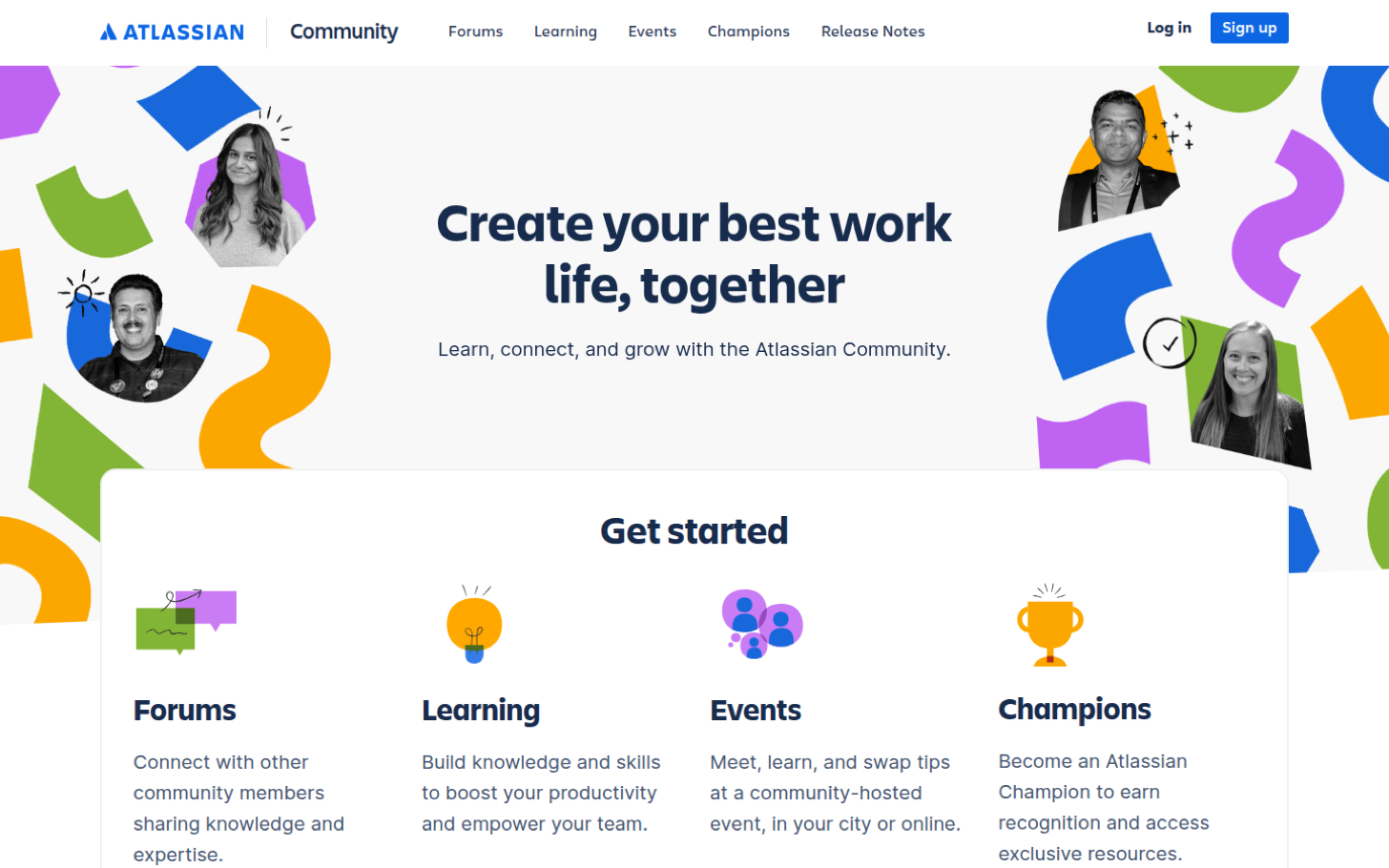
Community is the one channel that does not wait for you to ask. A branded online community produces customer feedback continuously: feature ideas, bug reports, real use cases, and praise nobody prompted, with no survey to launch. Atlassian's community is the textbook version, customers answering each other and voting on what gets built next, edge cases surfacing the day they appear.
Thought Industries is the one I point customers to: after moving its community to Bettermode, the team pulled customer feedback that had been scattered across channels into one place with real analytics, and a fragmented inbox became an actual product strategy. The community deflects support tickets while it does all of this, which is the kind of two-for-one that makes a CFO pay attention.
How to build a VoC program that runs itself
A repeatable voice of the customer program beats a heroic one-time push, and most of it is plumbing rather than inspiration. This is the build order I use.
Build it like plumbing, not inspiration1Set the objective. Tie it to one goal, like cutting churn, with a metric attached.2Map channels to the journey. Decide which methods cover which moments, from onboarding to renewal.3Centralize the inputs. Surveys, tickets, reviews and posts funnel into one place.4Tag and analyze. Code by theme and sentiment so the patterns become visible.5Route to an owner. Every theme goes to the team that can act on it.6Close the loop. Tell customers what you changed, and why.Keep only one step? Keep "close the loop."
- Set the objective. Tie the program to one goal, like cutting churn or de-risking a roadmap bet, with a metric attached. A program that measures everything proves nothing.
- Map your channels to the journey. Decide which methods cover which moments, from the onboarding survey to the renewal call.
- Centralize the inputs. Funnel surveys, tickets, reviews, and community posts into one place. Dedicated software helps at scale, but an honest spreadsheet beats six disconnected tools you never open.
- Tag and analyze. Code each piece of feedback by theme and sentiment so the patterns become visible instead of anecdotal.
- Route to an owner. Every theme goes to the team that can act on it. Unassigned insight is just trivia.
- Close the loop. Tell customers what you changed and why. This is the step that buys you the next round of honesty.
If you have nothing today, you can still start tomorrow. Post one question to your community, or email ten customers, and ask "what almost made you give up on us this month?" I have run that exact question at a fintech where I led demand gen, and the answers were so specific they rewrote the next quarter's roadmap. That one question will fund the rest of the program.
Turning raw feedback into something leadership reads
This is where most programs stall, buried under customer data they collected and never opened. The fix is boring and it works: tag everything by theme, severity, and segment, then track how the volume of each theme moves over time. Sentiment analysis tools can score thousands of comments of customer feedback quickly, which genuinely helps you catch a shift in customer sentiment early, but a human still has to read the outliers. The sharpest insight usually hides in a weird edge case no model thinks is important.
What you are building toward is a one-page monthly readout: the top five themes, the customer needs behind each, and what changed since last month. I have sent versions of that one-pager to executives for years, and the lesson never changes. A dashboard with forty metrics gets closed. A one-page memo with five themes and the actionable insights behind them gets forwarded to the CEO. Write for the second one.
Closing the loop, the step everyone skips
Closing the loop is where trust is built or quietly lost, and it is the step teams skip most.
The feedback loop: close it or skip the program1 · ListenHear it across surveys, tickets, reviews and the community.2 · AnalyzeTag by theme and sentiment. Find the pattern, not the anecdote.3 · ActShip the fix, or decide not to, on purpose.4 · Tell themSay what changed, where the request started. Everyone who voted sees it.Every cycle, back to listening. People forgive a missing feature, not being ignored.
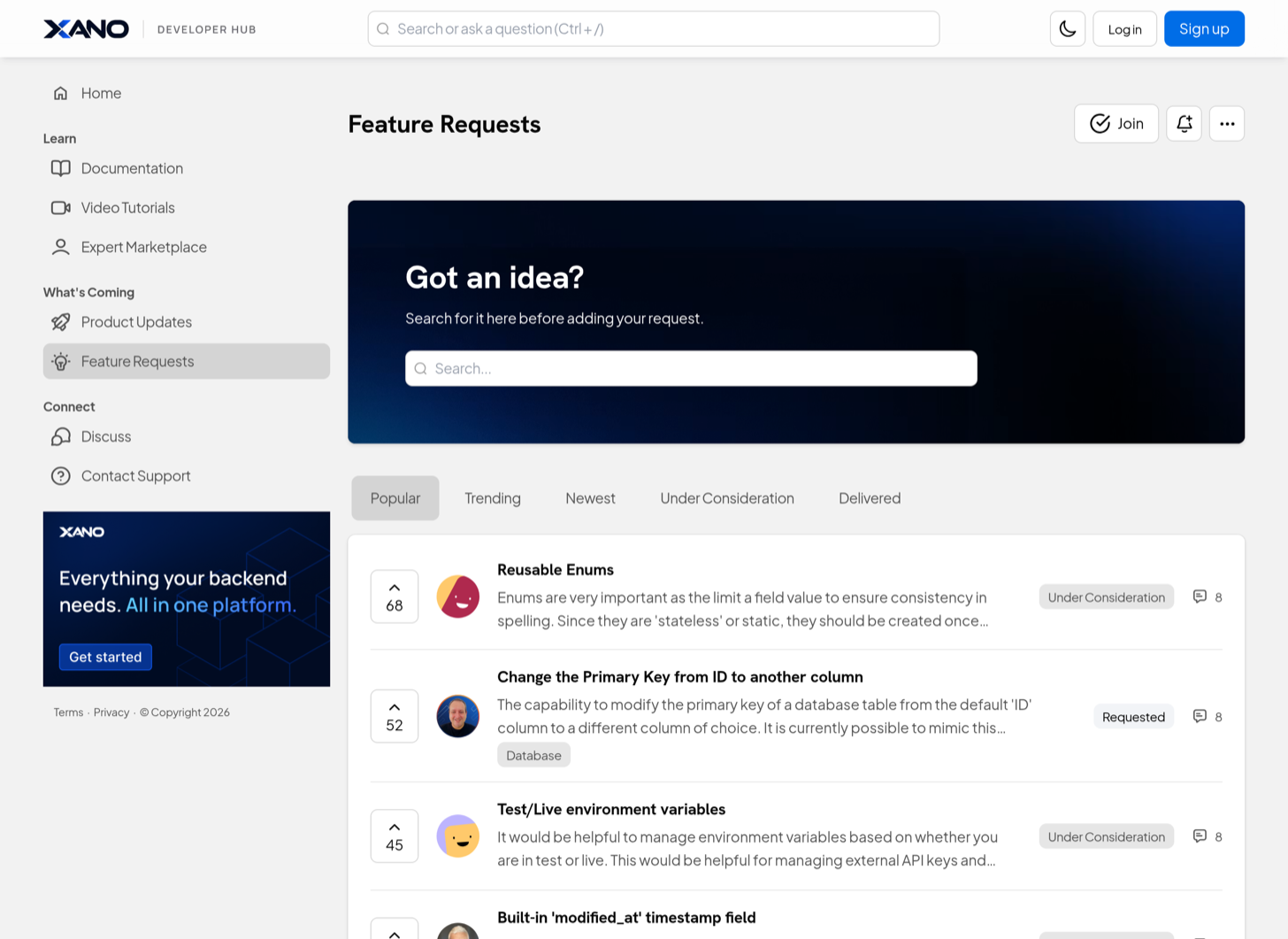
When a customer reports a bug or asks for a feature, follow up when you ship it, and follow up just as plainly when you decide not to. Silence reads as "they did not care." A public community makes this scale beautifully: post the resolution where the request started, and everyone who upvoted it sees the outcome at once. Good feature request management turns a private backlog into a pipeline customers can actually watch.
Here is what that looks like in a live community. This is Xano's feature-requests board, running on Bettermode. Customers post an idea, everyone else upvotes it, and the status moves through "under consideration" to "delivered" in plain sight. The request, the vote, and the "we shipped it" all sit on one page, which is closing the loop turned into a feature.
That single habit does more for retention than most loyalty programs, because people forgive a missing feature far more easily than being ignored.
Why most VoC programs quietly die
I have watched more VoC programs die than survive, and they almost never go out loudly. They just stop. Here is how it usually happens, so you can see it coming.
The first killer is collecting faster than you can process. A shiny new survey tool makes asking so cheap that you end up with ten thousand responses and nobody with time to read them. Unread feedback is worse than none, because now you have proof that you asked and ignored the answer.
The second is the ownership vacuum. When VoC is "everyone's job," it quietly becomes no one's, and the themes pile up unassigned until the spreadsheet turns into a museum.
The third is worshipping the number. An NPS score climbs or falls on a quarterly slide and not one person in the room can say what they did about it. A metric you cannot act on is decoration.
Then there is tool sprawl, which I have caused personally. Six tools, each holding a slice of the truth, none of them reconciled, and a frantic quarterly stitch-up to turn them into a story. If you take one thing from this section, make it this: one honest spreadsheet beats six dashboards you never open.
One last thing nobody warns you about. The day you start listening properly is the day you also become the person who has to tell customers no. Congratulations, you just joined product management 🎉. Saying no, in public, with a real reason, is part of the job now, and it turns out to be the part that builds the most trust.
What a mature VoC program earns you
Run a voice of the customer program consistently and the relationship changes. Customers who feel heard stay longer, spend more, and keep handing you the raw material to get better. That compounds, quietly, into the kind of retention you cannot buy back later with discounts.
It also feeds the next motion. The customers who give you the best feedback tend to be your best future advocates, so a VoC program and a customer marketing program are really one engine running in two gears. The teams doing this well lean on dedicated tools downstream: SlapFive to capture proof in the customer's own voice, audio and video instead of a tidy pull quote, and Base.ai to find advocacy candidates in the data and tee up the outreach. Both can connect to a community, where the rawest customer voice already lives.
If you would rather not stitch five tools together to begin, that is the case for an always-on community as the spine of the program. Bettermode gives you one branded place where feedback, feature requests, and customer conversations sit together, get tagged, and turn into action people can see. It is the version of "listen to your customers" that actually does something with what it hears. It is also the part I get to watch work every day, and after a career spent lifting my best ideas straight from customers, that is not a small thing to say.
FAQ
What is the difference between VoC and customer feedback?
Feedback is a single signal: one survey response, one review, one complaint. Voice of the customer is the system that collects those signals across channels, makes sense of them, and routes them to action. Feedback is the input. VoC is the discipline you apply to it.
Is voice of the customer the same as market research?
No, and conflating them is expensive. Market research studies a market you do not serve yet, to decide where to play. VoC listens to the customers you already have, to keep them and grow them. You need both, but only VoC tells you why this quarter's renewals are wobbling.
How often should I collect VoC data?
Match the cadence to the channel. Transactional surveys fire on an event, relationship surveys run quarterly, and community listening never stops. The trap is collecting faster than you can process, because unread feedback is worse than none. People notice when they speak and nothing happens.
Who should own the VoC program?
Whoever owns the customer experience end to end, usually CX or customer success, with product and marketing as standing partners. Ownership matters less than routing, though. A program where every theme has a named owner beats a perfectly staffed one where insight piles up unread.
What is the most cost-effective way to collect feedback?
Per insight, an always-on community wins. It produces feedback continuously, deflects support questions while it does, and doubles as the home for advocacy. Surveys still earn their place for benchmarking over time. But if I could keep only one channel, I would keep the community.
TL;DR
- Voice of the customer is the system for collecting feedback across channels, making sense of it, and acting before customers repeat themselves. Feedback is the input; VoC is the discipline. It is not market research, which studies a market you do not have yet.
- Companies are usually wrong about their own experience: Bain found 80% think they deliver a superior one, while 8% of customers agree. Closing that gap tracks with growth (Forrester: 2.4x revenue, 2x profitability for aligned firms).
- Blend channels for what each does best: surveys for trends, interviews for the why, reviews for unfiltered and competitive signal, support tickets for what is broken now, and community for always-on feedback.
- Build it like plumbing: one objective, channels mapped to the journey, inputs centralized, feedback tagged, every theme routed to an owner, loop closed.
- Most programs die from collecting faster than they process, no clear owner, vanity metrics, or tool sprawl. Close the loop, or skip the program. People forgive a missing feature; they do not forgive being ignored.
- For the lowest cost per insight, an always-on community is the spine of the whole thing. That is the case for Bettermode.