Slack vs. Discord: The Ultimate Comparison

With a great variety of community collaboration tools on the market, it can be hard to choose the one that fits all your needs. This guide compares the top-rated platforms—Slack vs. Discord—to help you choose the best option for your use case.
Companies focused on customer needs see better growth and retention. With more tools available than ever, now is a great time to build an online community. The biggest question: which platform is best to build your community on?
What Is Slack?

Slack is a communication platform that people use to connect, chat, collaborate, and keep in touch. You can access Slack through a browser, mobile app, or desktop app.
As a Slack user, you can exchange instant messages—both direct messages and group messages called Channels. Slack offers features like screen sharing, and its app directory makes it possible to integrate with lots of other apps.
Slack Key Features
- Instant messaging: Real-time chat with direct and group messages organized into Channels
- Audio and video calls: Voice and video conferencing directly within the platform
- Slack Connect: Enables teams from different organizations to work together in real time
- Integrations: Over 2,000 third-party apps including Google Drive, Trello, Zoom, Asana, and Salesforce
Slack Pricing
Free plan:- Limited features- 90-day message history limit- 10 app integrations maximum
Pro plan: $8.75/user/month- Unlimited message history- Unlimited integrations- Group video calls (up to 50 people)
Business+ plan: $15/user/month- Enhanced security features including SAML-based SSO- Advanced reporting and analytics
Enterprise Grid: Custom pricing
Slack Pros and Cons
Pros:- Good for text-based group conversations and video calls- 10+ integrations in free version, hundreds more in paid plans- Easy real-time file sharing and collaboration- Screen sharing options and emoji reactions- Advanced search and file pinning
Cons:- Minimum file storage on free plan; slowly deletes files over time- Cannot be customized for brand communities- Search limited to content from last 90 days on free plan- Notifications can be overwhelming- Lacks event management, moderation, and gamification
What Is Discord?
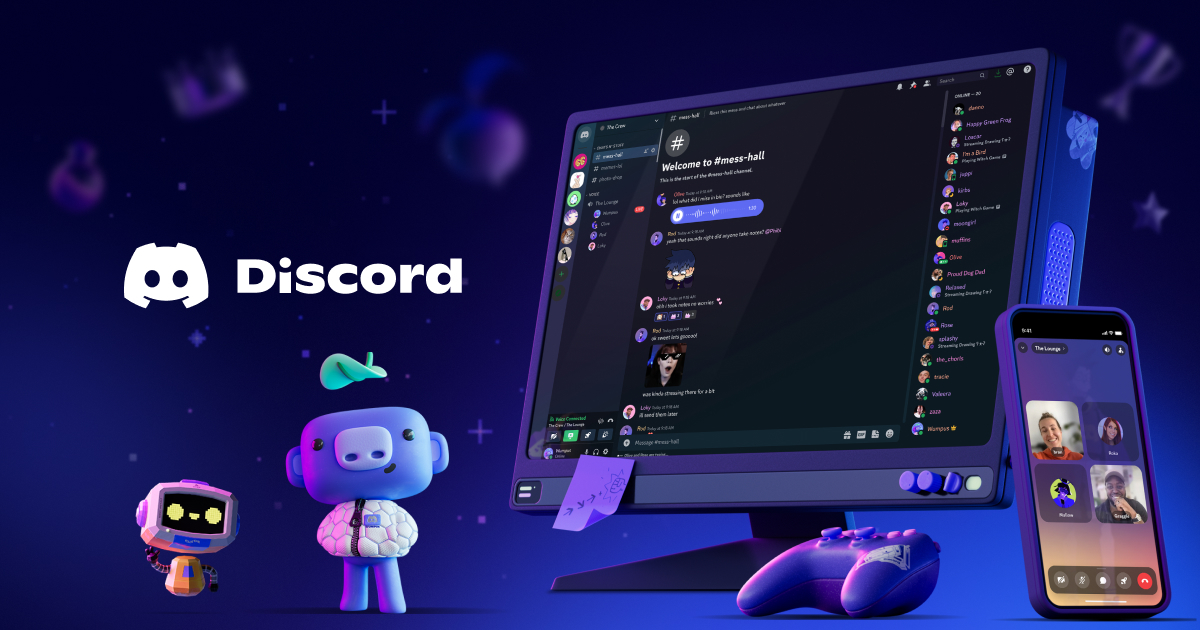
Discord is an instant messaging voice, video, and text chat app—mainly used for gamers, private invite-only groups, and other communities.
Discord is made up of spaces called Servers and channels. These are usually dedicated to specific topics and can have different rules. The founders originally created Discord as a communication tool for voice calls with gamer friends.
Discord Key Features
- Voice messaging: Superior voice chat capabilities designed for gaming
- Text and video chat: Full communication suite
- Server structure: Organized spaces with channels for different topics
- Bot integrations: Automate tasks like moderation, music, and notifications
- Streaming integrations: Connects with Twitch and YouTube
Discord Pricing
Free plan:- Unlimited messages- Voice and video chat- Up to 8 MB file sharing
Discord Nitro: $9.99/month- Up to 500 MB file uploads- HD video streaming- Server boosting perks- Custom tags and animated avatars
Nitro Basic: $2.99/month- Most Nitro features except server boosts- 50 MB file uploads
Discord Pros and Cons
Pros:- Personal, group, and server-based messaging- Handles text, images, video, and audio calls well- Browser and desktop capabilities with bot support- Mobile version with cross-platform use- AI chatbots help automate moderation and onboarding
Cons:- Communities can't be white-labeled- Fewer customization options for branding- UI can get cluttered and confusing- Post composer not powerful enough for rich content- Limited moderation and safety controls- Lacks gamification tools
The Community Platform Alternative- Bettermode
While brands can dive into community building with basic tools, scaling successful brand-led communities requires the right technology.
Both Slack and Discord offer great features for collaboration through instant messages, video, and file sharing. But they both prioritize building their own brands over promoting yours. True community-building features are lacking, and notifications from other communities are constant distractions.

Dedicated community platforms bring a lot to the table. You get complete ownership of your community, meaning your brand stays in control rather than being at the mercy of a third-party algorithm. Gamification features like leaderboards, badges, and reputation systems keep members engaged and coming back. Customization is another big advantage—design studios give you full visual control so your community actually looks like it belongs to your brand.
If you want to integrate forums directly into your existing website, embed tools make that straightforward. SEO optimization is typically built in, helping your community content get discovered organically. You can also host online events right within the platform, and rich analytics let you track everything from engagement patterns to trending content and member activity.
Comparison table: Slack vs. Discord vs. Bettermode
| Bettermode | Slack | Discord | |
|---|---|---|---|
| Suitable for | B2B SaaS customer communities | Internal business messaging | Gaming and hobbyist communities |
| Primary communication | Text with rich media, Q&A, ideation | Text | Voice (also supports text) |
| Pricing | Starts from $149/mo | Free / Standard ($8.75/user/mo) / Plus ($15/user/mo) | Free / Nitro ($9.99/user/mo) / Nitro Basic ($2.99/user/mo) |
| CRM Integrations | 🟢 HubSpot, Salesforce, Zendesk | 🟠 Limited | ❌ |
| Spaces (Groups/Channels) | 🟢 Public, Private, and Secret | 🟠 Public and secret channels | 🟠 Public and secret channels |
| Discussion threads | 🟢 | 🟢 | ❌ |
| Moderation tools | 🟢 Automated and manual methods | ❌ | 🟠 Need to install third-party bot |
| Gamification tools | 🟢 Badges, leaderboards, reputation scoring | ❌ | 🟠 Basic gamification |
| Single Sign-On (SSO) | 🟢 JWT, OAuth2.0, SAML, and Custom SSO | 🟠 Only SAML-based SSO | ❌ |
| Reporting and analytics | 🟢 Built-in dashboard for key metrics and integrations | 🟠 Slack has limited analytics | ❌ |
| Multilingual support | 🟢 | ❌ | 🟢 |
| Fully white-label | 🟢 | ❌ | ❌ |
| Data ownership | 🟢 | 🟠 | ❌ |
| Enterprise security (SOC2) | 🟢 | 🟢 | ❌ |
When to Choose Each Platform
Choose Slack When:
- You need real-time text messaging for internal business communications
- Your team is already using Slack for work
- You want deep integrations with business tools
- You're building a small, closed community
Choose Discord When:
- Real-time voice messaging is essential
- You're building a gaming or hobbyist community
- You need a free solution with unlimited message history
- Your audience is already familiar with Discord
Choose a Dedicated Community Platform When:
- You want to build a brand-led community
- Customization and white-labeling matter
- You need advanced moderation and gamification
- SEO and public discoverability are important
- You want comprehensive analytics
- You need event management and knowledge bases
Conclusion
When deciding which platform is right for you, consider which features are essential:
- Slack: Best for real-time text messaging for internal business communications
- Discord: Best for real-time voice messaging and gaming communities
- Dedicated platforms: Best for brand-led communities requiring customization, moderation, and analytics
Community platforms designed for B2B SaaS—like Bettermode—provide everything you need to build brand-led communities: customization, moderation tools, gamification, SEO benefits, and comprehensive analytics.
Ready to build a community that represents your brand? Get started with Bettermode.
FAQs
What's better, Slack or Discord?
Slack is mainly designed for professional communication, making it great for businesses that need organized collaboration. Discord is tailored more for community engagement and social interaction, with superior voice messaging. The best choice depends on your specific needs.
Does Slack have roles like Discord?
No, Slack doesn't have roles like Discord. Discord offers customizable roles to manage permissions. Slack uses channels and access controls instead, but doesn't have the same level of role management.
Why is Slack so popular?
Slack simplifies business communication with organized channels, direct messaging, file sharing, and integrations with numerous apps. Its real-time collaboration and powerful search make it popular for team workflows.
Which is better for community building?
Neither Slack nor Discord is ideal for brand-led community building. Both lack advanced moderation, gamification, SEO capabilities, and white-labeling. Dedicated community platforms are better suited for building branded communities.

Bettermode Blog


Book a demo
Discover how Bettermode fits your business.