Engagement and Growth Secrets for Brand Communities

Community engagement is paramount to solidifying customer loyalty, creating brand evangelists, and selling future products and services. However, increasing engagement and driving growth is no simple task for community managers.
More than half of community professionals identify consistent engagement as one of their biggest frustrations with running online communities. Even though it can be overwhelming to strategize engagement tactics, being present with your community is the most important step.
Perhaps the key to community engagement is creating an accepting, judgment-free environment. Cultivating welcoming and natural connections goes far in building a sense of belonging within a thriving community.
Why Community Engagement Matters
Engagement develops and nurtures the sense of belonging in the community, which results in member retention and brand loyalty. Without engagement, members gradually lose connection, and it becomes increasingly hard to move them through different lifecycle stages.
The most valuable customers are the ones you can build emotional connection with. You have to earn word of mouth—you can't just buy it. You must put in time and effort to create a thriving community.
Benefits of Creating a Brand Community
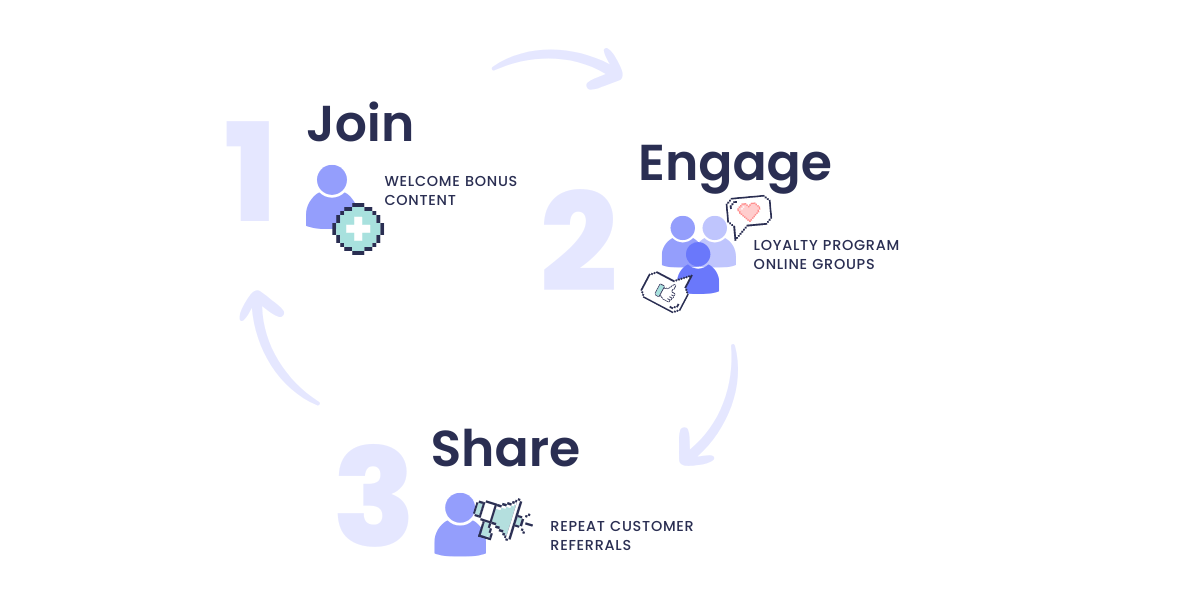
Create an environment where everyone is excited about your product and mission. By investing in a brand community, you're investing in relationships in your niche and controlling how your content is presented to consumers.
Assemble your superfans. There is nothing more powerful than two of your super consumers talking about how much they love your product in front of a prospect. The vast majority of people trust brand recommendations from people they know.
Lower acquisition costs while increasing lifetime value. Branded communities reduce the cost of client acquisition while increasing the lifetime value of your clientele.
Positioning Your Community to Attract Members
It can be difficult to spread the word about your community, let alone convert prospective members into active users. Simplify the process by getting intentional about your community's value proposition.
Make the value loud and clear. Your community should offer something for members to gain—whether that's networking, personal development, achieving goals, or receiving perks. Give members something in return to attract active participants.
Create a place where members go for answers. Your community's angle should be knowledge-based. Learn what frustrates your prospective members and what struggles they face. Then create a collaborative and co-creation environment early on with feedback loops.
Understand pain points and leverage features. Figure out how to use community features to grab the attention of new members by addressing their specific challenges.
Handling Low Engagement Early On
It's normal to have low engagement at the beginning. Before panicking, create your own engagement metric unique to your community.
For example, you could measure how many people received answers to questions on a given day, or how many members participated in the latest challenge. Devise an engagement metric unique to your niche rather than comparing to generic benchmarks.
Build Your Avengers
When trying to build a branded community, first find 10-15 highly-engaged community members. Glorify them and put them on a pedestal. Those people become your brand's super consumers, influencers, and best advocates.
The fastest way to find this group is to host a cohort class. A class allows students to go on a journey together or share an experience. Pair the course with weekly office hours to start a ritual or meeting point. These are ways to get your best members to show up regularly.
Embrace Community-Led Growth
Community-led growth is a go-to-market strategy where companies build communities of enthusiastic customers. When done well, these communities add significant value to the product experience. Let your members do the heavy lifting by helping and supporting each other.
Growing from One-to-Many to Many-to-Many
Create accountability groups within your community if you want to grow to a many-to-many platform. Build a reliable weekly or monthly meeting where members receive something for their participation. Giving feedback and advice contributes to sustainable growth.
Distribute Content Widely
Take content from your community and distribute it to all internet users, not just members. Go to the social media platforms where your target audience is most active—whether that's Twitter, LinkedIn, or other forums. You'll slowly increase brand awareness and drive prospective members to your community.
Plant seeds across multiple ecosystems. You're not looking to go viral but to understand which type of content receives the most activity. Periodically reach out to members for case studies and qualitative feedback—those insights will help you grow.
Growing a Small but Active Community
If you have a small but active community and want to expand, go to your community for help. Hand-to-hand networking works—ask community members what would incentivize them to invite three friends.
Get clear on your value proposition. A community should not just be about plugging your company's services and products. Dive into the viewpoint of your community members, align with their needs, and get feedback on what type of content they want.
Expand your value proposition. Your members desire more than just being amazing at using your product. A bigger value proposition is helping them crush their career or achieve broader goals. Brands that go above and beyond advertising their products increase their value proposition and retain members more easily.
Content Inspiration When You're Stuck
Even though constantly churning out content can be challenging, talk to your members and create case studies. Ask members what they're interested in and what they want to hear from you.

Start an accountability group to gather information about member interests. Use tools like AnswerThePublic to see what people are searching about your topic—it might spark inspiration.
Steal like an artist. Look at another community or content stream and see what's working for them. While engagement tactics work, dive into the psychology of why those tactics work and how they make people feel.
Managing Multilingual Communities
For multilingual communities, operate under one umbrella community of the majority spoken language, then create sub-communities hosted in other languages.
Even though promoting in English is easy, users still need resources in their native language. Creating community in specific languages is a major plus for establishing yourself within countries.
Don't shy away from hosting communities in multiple languages. Many people speak more than one language, and there's an overlap between languages. Make sure to have moderators who speak multiple languages so they can efficiently communicate in those sub-communities.
Key Takeaways
Driving Community Engagement
- Get clear on your community's value proposition—what's in it for members?
- Create accountability groups—find reasons for members to participate
- Assemble your avengers—lift up and spotlight your most active members
Increasing Membership
- Take content from your community and spread it across multiple online groups
- Get qualitative feedback about what's working and what would incentivize referrals
- Get inspired by other successful communities and adapt their content ideas
Generating engagement and increasing membership isn't easy, but there are steps you can take to find the recipe for success.
Ready to build an engaged community? Talk to sales for a demo.
FAQs
Is it normal to have low engagement when starting a community?
Yes, completely normal. Communities take time to build momentum. Focus on identifying and nurturing your most engaged early members—they become the foundation for growth. Create engagement metrics specific to your community rather than comparing to established communities.
How do we get members to engage without feeling forced?
Create genuine value through content, connections, and resources. Make participation rewarding through recognition, gamification, and tangible benefits. When members get real value, engagement becomes natural rather than forced.
What's the best way to grow community membership?
Word of mouth from satisfied members is most effective. Make it easy for members to invite others, ask what would incentivize them to refer friends, and create shareable content that extends beyond your community to social platforms.
How do we maintain engagement as the community grows?
Create sub-groups and accountability circles for different interests or member types. Develop rituals like weekly events or challenges. Continue spotlighting active members. As community grows, peer-to-peer engagement should increase, reducing dependence on your team.