Knowledge base software in 2026: 11 tools compared on real pricing

Knowledge base software is a tool for writing, organising and publishing articles that answer questions, either for your customers in a help center or for your own staff in an internal wiki. The good ones are judged on how well people find the right article, not on how many articles you can store.
That sounds obvious, and it is where most software choices in this category go wrong. Teams buy a knowledge management solution built for one audience and then try to serve the other with it, which is how you end up with a customer help center that reads like internal documentation, or an internal wiki nobody outside the founding team can find anything in.
So before comparing knowledge base tools, pick your side. And keep one newer option on the radar while you do: some teams now run their customer knowledge base inside a community, where documentation, member answers, and staff replies live in one searchable place and the content refreshes itself as customers ask. We compare that route in our guide to community forums.
Internal knowledge bases and customer facing knowledge bases are different products
An internal knowledge base is a memory for your team. It holds onboarding material, process docs, decisions and the answers your support agents need while they work, which is how tribal knowledge stops living in one person's head. The key features are fast capture, permissions, version history and search functionality that reaches into the other tools your team lives in, like Google Drive or Slack threads. For distributed teams it doubles as the substitute for overhearing things.
A customer facing knowledge base is part of your product experience. It is public or gated behind a login, it needs to look like your brand, it has to be indexable by search engines when it is public, and it is measured in support tickets that never got raised. This is the customer self service side of the category, and it is part of the customer experience whether you treat it that way or not. Technical documentation for developer products sits here too.
A few knowledge management tools genuinely do both, and a handful of vendors market the same product as both a help center and a knowledge management platform. Most are much better at one, and the pricing model usually gives away which. Per-agent pricing signals a customer support tool. Per-member or per-user pricing signals an internal knowledge management software product.
Two things worth knowing before you start collecting quotes. Some vendors in this category now use custom pricing and publish no rates at all, so budgeting means booking a call first. And AI powered features are almost always a separate line item in 2026, whether that is an add-on price per agent or a credit balance, so the sticker price and the price of the same knowledge base platform with AI powered search enabled are rarely the same number.
The eleven knowledge base tools below are grouped by which side they serve, with what each one actually costs. The key features worth comparing differ by group, so the two lists are judged on different things.
Customer facing knowledge base software
Zendesk
Zendesk Guide sits inside the wider Zendesk support suite, which is the reason most people end up with it: the help center and the ticketing system share one system of record, so a knowledge base article can be suggested during a conversation and a gap in the docs shows up in ticket data alongside customer satisfaction scores.
Pricing is per agent, billed yearly: Support Team at $19, Suite Growth at $55 and Suite Professional at $115 per agent per month. Copilot, the AI layer, is a $50 per agent per month add-on on top.
Best for customer support teams who want the knowledge base and the tickets in one place, and who already run Zendesk.

Intercom
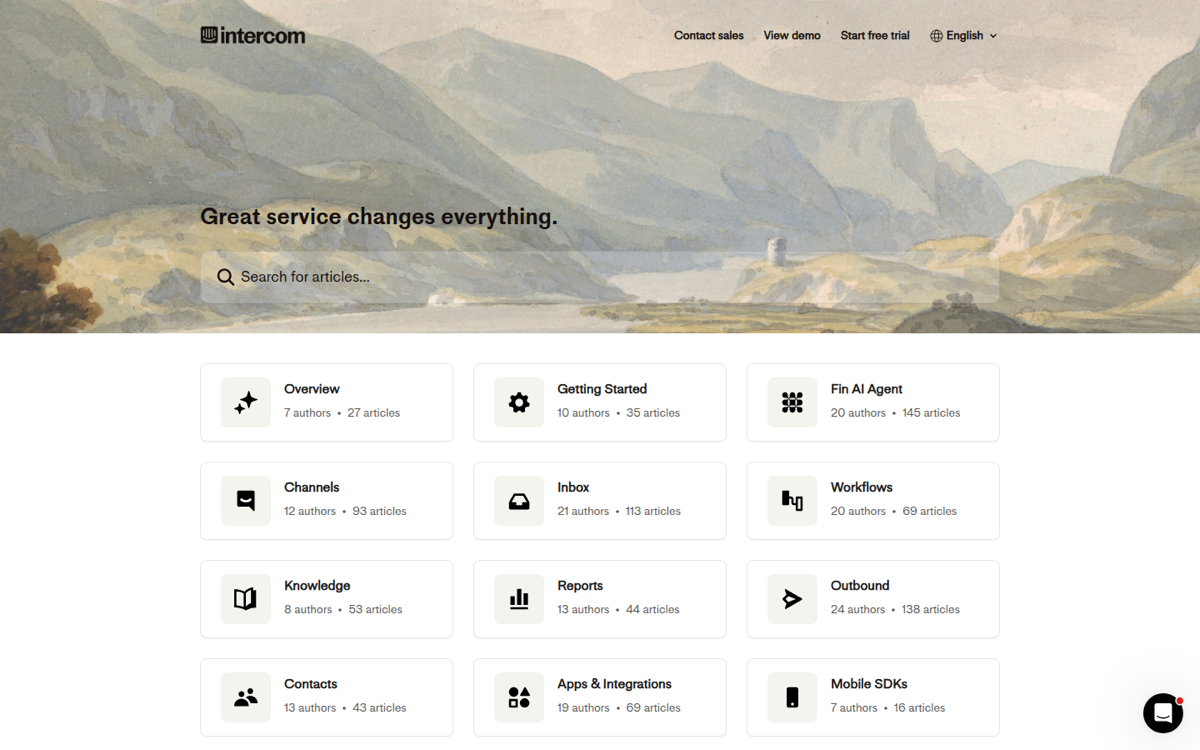
Intercom's articles product is built around its messenger, so the same content answers questions in the widget, in the help center and through Fin, its AI agent. If most of your support happens in a chat window rather than an email queue, this is the natural fit.
The Essential plan is listed at $29 per seat per month, with $19 per seat shown for annual billing. Fin is charged by outcome rather than by seat, starting from $0.99 per resolution, which makes the total depend on volume rather than headcount.
Best for product-led companies whose support already runs through in-app chat.
Document360
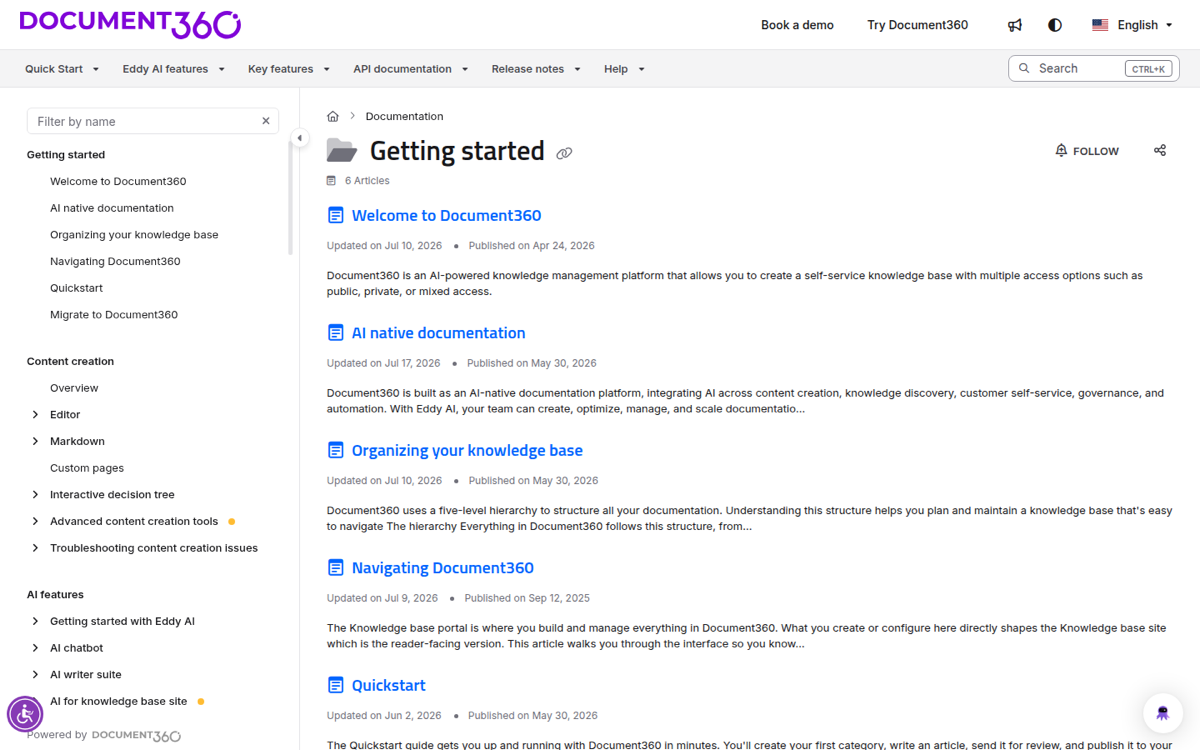
Document360 is a dedicated documentation platform rather than a support suite, and it shows in the authoring experience: reusable content blocks, category management, revision history, a glossary, workflow states and translation. It is aimed at teams whose technical documentation is a product in its own right, like API references or developer manuals.
Document360 does not publish prices. The pricing page is a three-step form that asks what you are solving for before routing you to a quote, so expect a conversation before you can budget. The page lists SOC 2 Type II, ISO 27001:2022 and GDPR.
Best for documentation-heavy products where authoring workflow matters more than ticketing.
Helpjuice
Helpjuice has stayed narrow for over a decade: a knowledge base, done properly, with a design team that customises the theme for you as part of onboarding rather than handing you a template.
Pricing is refreshingly flat. It is $249 a month including 30 users and 12GB of file storage. Note that the AI suite, which covers the AI writer, AI search and the chatbot, is not included at that tier, so ask where it sits if AI matters to you.
Best for teams who want one well-built knowledge base and a predictable bill regardless of headcount.

ProProfs Knowledge Base
ProProfs covers a wide spread of use cases with the same product, from a public help site to internal SOPs, training and compliance material. Its pricing is per author rather than per reader, which suits a small documentation team publishing for a large audience.
There is a free plan capped at 25 pages. Paid tiers run $49, $69 and $79 per author per month, and the enterprise plan starts at $499 a month on annual billing.
Best for small teams publishing a lot of pages who want the free tier to prove it out first.
Freshdesk
Freshdesk bundles a knowledge base with its help desk in much the same shape as Zendesk, usually at a lower entry price, and it is a common landing spot for teams who found Zendesk heavier than they needed.
It starts at $19 per agent per month billed annually, with the next tier at $55. Freddy AI Copilot is a $29 per agent per month add-on.
Best for support teams who want help desk and help center together without enterprise-tier pricing.

Internal knowledge base software
Confluence
Confluence is the default internal wiki in companies that already run Jira, and the integration is the whole argument: documentation, tickets and project management in one account, with pages that link naturally to the work they describe.
There is a free tier for up to 10 users. Standard is $5.42 and Premium $10.44 per user per month, with Enterprise on annual billing only. Per-user pricing at that level makes it one of the cheaper ways to give a whole company a wiki.
Best for engineering-led organisations already inside the Atlassian stack.

Notion
Notion is a general workspace that a lot of teams use as their internal knowledge base, and it is genuinely good at it as long as someone owns the structure. Left alone it sprawls, because the same flexibility that makes it pleasant to write in makes it easy to nest a critical doc four levels deep.
Free for individuals, Plus is $10 and Business $20 per member per month, with Enterprise on request. AI agents are metered separately, from $10 per 1,000 monthly credits, and connecting a custom domain to a published site is $8 a month on annual billing.
The learning curve is gentle for writing and steeper for team collaboration conventions, which is usually what decides whether it stays usable.
Best for teams who want docs, notes and light project management in one tool and will assign someone to keep it tidy.

Slite
Slite is narrower than Notion on purpose. It is built to be a company's internal knowledge base and nothing else, with verification workflows that flag when a doc is no longer up to date and an assistant that answers from your own content.
Basic is $10 and Pro $20 per user per month billed yearly, with Enterprise on request.
Best for teams who want an internal wiki that actively fights rot rather than a blank canvas.

Guru
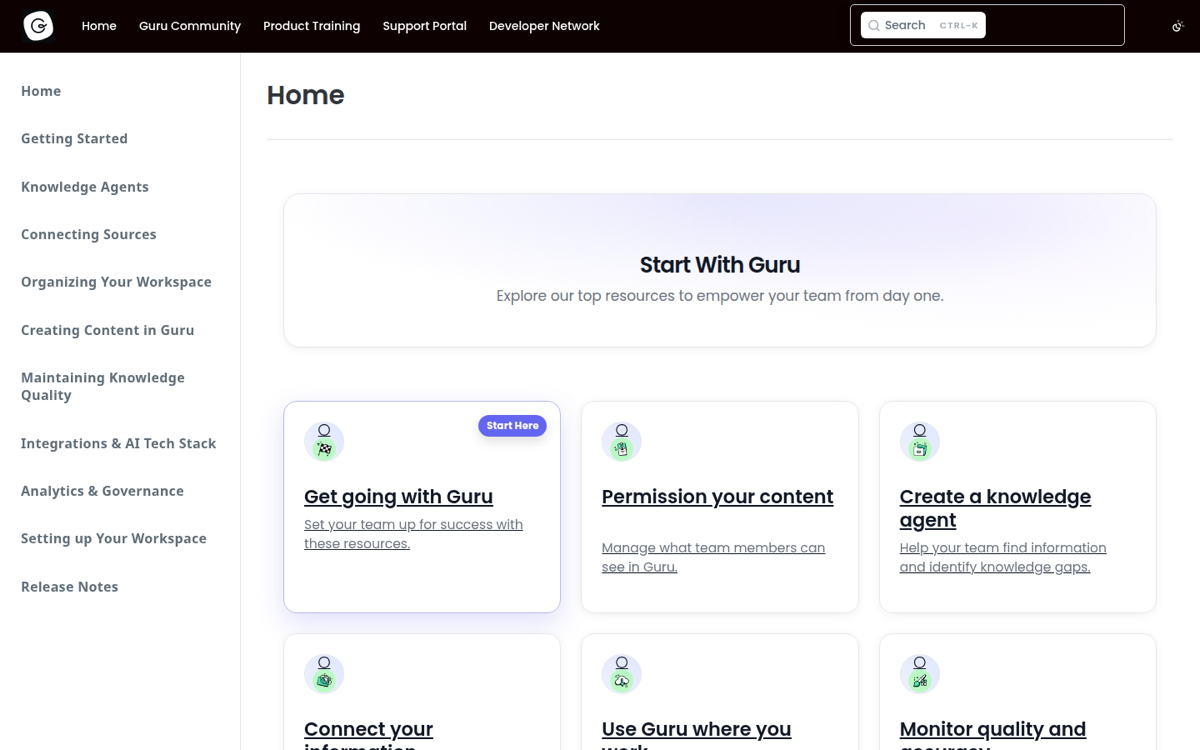
Guru's angle is that knowledge should reach people where they already are, so it surfaces verified answers inside the tools your team uses rather than asking them to visit a wiki. It has moved firmly upmarket, positioning as an enterprise knowledge management system with verification workflows and permission-aware answers.
Guru no longer publishes prices. The pricing page describes a custom package built around your scale and knowledge complexity, with a call to book. Budget accordingly.
Best for larger support and sales teams who need answers surfaced in the flow of work.
Bettermode
Worth being straight about this one: Bettermode is not a dedicated knowledge base tool, and if a standalone help center is all you need, several options above will serve you better.
Where it fits is the layer around the docs. A knowledge base answers the questions you anticipated. A community answers the ones you didn't, because other customers get there first, and those answers become searchable content alongside the official articles. Search spans discussions, articles and the knowledge base together, and the whole thing carries your branding.
Starter is $149 a month on annual billing, which is $1,788 a year, or $199 month to month, and covers up to 10,000 members and 5 collaborators. Growth is $1,500 a month annually, $18,000 a year, or $1,750 month to month.
Best for B2B SaaS teams whose customers already answer each other, and who want that captured next to the documentation.
Bettermode now includes Toggy, three AI agents for the community. For support teams the useful one is Toggy Grow: it keeps track of who has answered what, so a question that stalls gets routed to the member or expert who solved it before, and nothing goes out until you approve it. Toggy plans start at $750 a month. See what Grow would do with your support questions →

You probably do not have to choose
Most teams reading a comparison like this already run a knowledge base. The useful question is rarely whether to replace it.
If you use Zendesk, Bettermode's Zendesk app enables Zendesk knowledge base search from inside the community, so a customer types one query and gets both the official article and the thread where three other customers worked around the same problem. Federated search extends the same idea to external knowledge bases, pulling outside help docs into one search bar rather than asking people to check two places. Knowledge sharing stops depending on which system someone thinks to open.
The rest of the stack connects in the same spirit. Community posts can create Jira tickets, so a bug reported by a customer lands in the engineering backlog. Salesforce can create support cases from the community. Intercom contacts get enriched with member data, which is how community activity becomes something your CRM can report on. Slack notifies admins and moderators, Zapier covers the long tail, and a GraphQL API plus webhooks handle anything custom.
That is a different purchase from swapping documentation platforms. You keep the help center your team has already invested in and add the part it structurally cannot do, which is get your customers talking to each other in public where the answers stick around.
What actually decides this after you launch
Every vendor above will show you a demo where search works perfectly, because the demo content was written to be found. Four things separate the tools a year in, and none of them are on a feature grid.
Search quality is the whole product. A knowledge base is a search engine with a writing tool attached, so test it with the natural language your customers actually use, including the wrong words for your own features, rather than the terms your docs are titled with. AI powered search helps surface relevant information from badly titled pages, though it inherits whatever else is wrong with the underlying content.
Then there is maintenance, which is where knowledge management usually fails rather than at launch. Ask what the tool does when a knowledge base article stops being up to date: whether it can flag a review date, show you which pages get traffic but poor ratings, and tell you which searches returned nothing. That last one needs advanced analytics rather than a page-view count. Version control matters more than it sounds, because "what changed and who approved it" comes up eventually.
Deflection has to be measurable too. If the goal is fewer support tickets for your customer support function, you need to see which articles are read before a ticket is raised and which are read instead of one. Support teams that cannot answer that end up guessing at what to write next.
Permissions get complicated faster than anyone expects. Internal teams almost always need some content restricted by team, and customer facing knowledge bases often need a public tier plus a gated one for paying customers. Check that the model matches your reality before you migrate a few hundred articles into it.
How to choose the best knowledge base software for your team
The best knowledge base software is whichever one your audience will actually search, so the choice follows from who that audience is rather than from a feature count.
If you are equipping internal teams, shortlist Confluence, Notion, Slite and Guru, then judge them on capture speed and whether the knowledge management workflow survives contact with people who do not enjoy writing docs. If you are serving customers, shortlist Zendesk, Intercom, Document360, Helpjuice, ProProfs and Freshdesk, and judge them on search, branding and how the knowledge base article you publish today gets reviewed a year from now.
Two audiences skew this. Technical teams shipping API docs care about markdown, version control and publishing pipelines, and usually land on Document360 or Confluence. Enterprise teams care about SSO, audit trails and data residency, which tend to sit on an enterprise plan rather than a business plan, so get that quoted early rather than late.
Either way, price three scenarios rather than one: the plan you want, the same plan with AI powered search turned on, and the plan one tier up, because the key features that matter often sit above the tier you first budget for. SSO, advanced permissions and analytics are the usual culprits.
Then run the shortlist past the people who will maintain it. Customer support teams and documentation owners spot the friction a buyer never sees in a demo, and a knowledge management platform nobody wants to update is worse than a simpler one they will.
Frequently asked questions
What is knowledge base software?
Knowledge base software is a tool for creating, organising and publishing articles that answer common questions. It usually includes an editor, a category structure, search, permissions and analytics on what people read. Some products are aimed at internal documentation for your own team, others at a customer facing help center, and a few serve both.
What is the difference between a knowledge base and knowledge management software?
A knowledge base is the library: the articles themselves and the site that presents them. Knowledge management software describes the wider practice of capturing, verifying and distributing what an organisation knows, which includes the library but also the workflows that keep it accurate and the search that surfaces it. Vendors use the two terms loosely, marketing the same knowledge management solution as both, so compare key features rather than labels.
What is the best free knowledge base software?
Confluence has a free tier for up to 10 users, which is the most generous option here for an internal wiki. ProProfs offers a free plan capped at 25 pages, and Notion is free for individual use. Free tiers among knowledge management tools tend to limit users, page counts or the AI powered features rather than the core editor, so check which of those constraints you would hit first.
How much does knowledge base software cost?
For internal knowledge management software, expect roughly $5 to $20 per user per month. Customer facing tools priced per agent run about $19 to $115 per agent per month, and flat-rate options exist, like Helpjuice at $249 a month for 30 users. Two things inflate the final number: AI features are usually a separate add-on or credit balance, and some vendors, including Document360 and Guru, use custom pricing with no published rates.
Do we need a knowledge base and a community?
They answer different questions. A knowledge base covers what you already knew people would ask, written by your team and kept accurate. A community covers everything else, and it scales in a way documentation cannot because your customers do the answering. Teams running both usually connect them so one search covers everything, which is what federated search and the Zendesk integration are for.
Can a knowledge base actually reduce support tickets?
It can, though only when the article a customer needs is findable at the moment they need it, which is a search and maintenance problem rather than a writing volume problem. Measure it by looking at which articles are read immediately before tickets are raised, and treat searches that return nothing as your content roadmap.
How do I create a knowledge base?
Start from your support inbox, not a blank page: the twenty questions your team answers most are the first twenty articles. Write them in the customer's words, organise by task rather than by your org chart, and assign an owner per article so updates actually happen. Then watch search terms inside the knowledge base itself, because failed searches are next month's writing list.
TL;DR
- Knowledge base software splits into internal knowledge bases, which are team memory judged on capture and search, and customer facing knowledge bases, which are part of your product and judged on tickets avoided. Pick the side first, because per-agent pricing means a support tool and per-user pricing usually means an internal one.
- Customer facing picks: Zendesk ($19 to $115 per agent per month yearly) if tickets and articles should share one system, Intercom ($29 per seat, $19 annual, Fin from $0.99 per resolution) for chat-led support, Document360 for documentation-heavy products, Helpjuice ($249 a month for 30 users) for a flat bill, ProProfs (free to 25 pages, then $49 to $79 per author) for small publishing teams, Freshdesk (from $19 per agent) for a cheaper help desk pairing.
- Internal picks: Confluence (free to 10 users, then $5.42 and $10.44 per user) for Atlassian shops, Notion ($10 and $20 per member) if someone owns the structure, Slite ($10 and $20 per user) for a wiki that flags stale docs, Guru for enterprise answers surfaced in the flow of work.
- Document360 and Guru no longer publish prices, so budget a sales conversation. AI features are a separate line almost everywhere, whether per agent or by credit.
- Bettermode is not a standalone knowledge base and does not need to replace yours. Its Zendesk app brings Zendesk knowledge base search into the community, federated search pulls in external help docs, and Jira, Salesforce, Intercom, Slack and Zapier connect the rest, so community answers sit beside official articles instead of competing with them.
- All prices were read from each vendor's own pricing page in July 2026 and change often. Confirm current rates before you commit.